
If you sell enterprise software, services, or B2B solutions and you have been researching quartz events sponsor matching companies, you are probably trying to answer a practical question: is this a logo-on-a-banner sponsorship, or a pipeline engine built around qualified meetings? That distinction is everything.
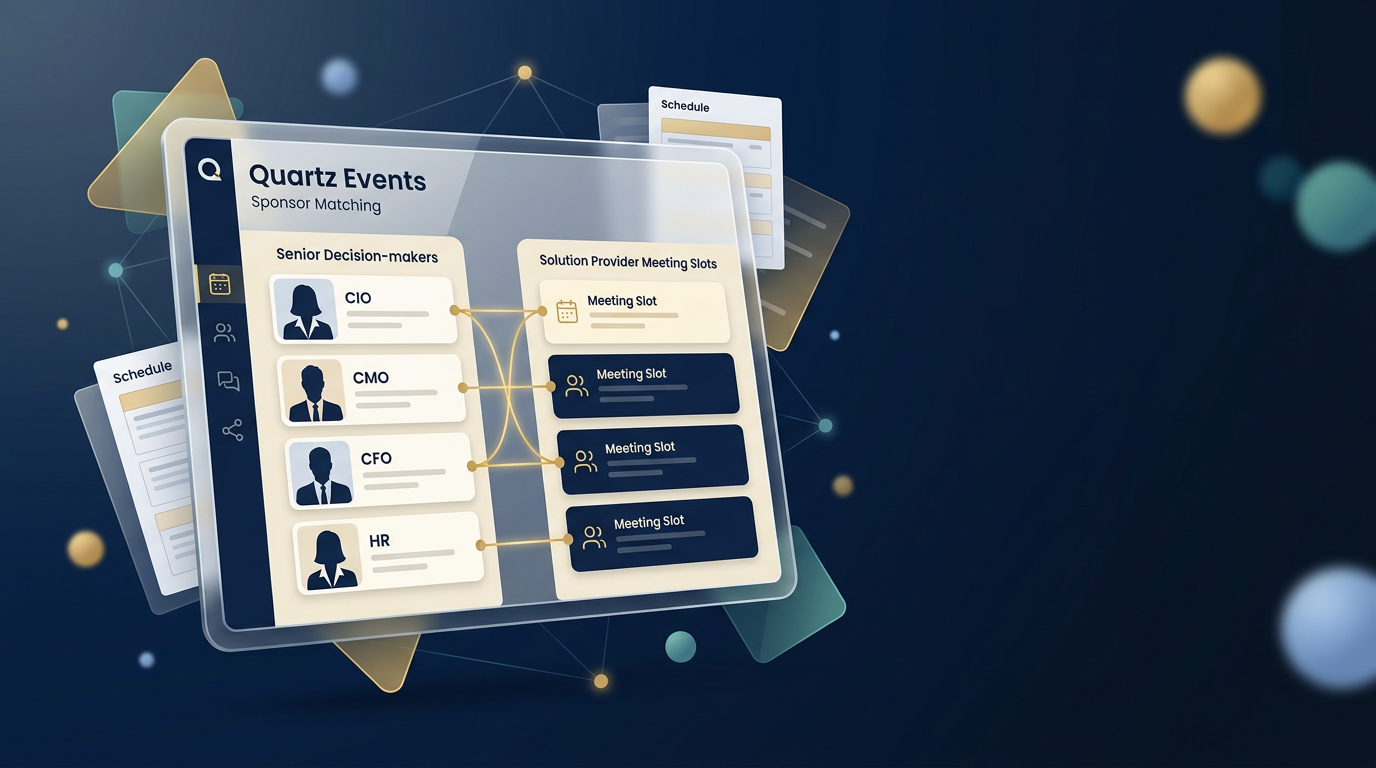
Quartz Events, now widely known as Quartz Network, runs invitation-oriented executive summits and virtual programs that pair senior decision-makers with solution providers through a curated matching process. Instead of hoping attendees wander past a booth, sponsor teams enter meetings with people who have already shared priorities, projects, and buying context. For many vendors, that is the entire pitch.
This guide explains the model in plain language. You will learn how the sponsor matching system works, who it is for, what companies typically buy, how it compares with traditional sponsorship, where the risks sit, and how to evaluate whether the format fits your sales motion. No fluff. No invented guarantees beyond what public materials and industry reporting support.
Quick Answer: What Quartz Events Sponsor Matching Means
When people search quartz events sponsor matching companies, they are usually looking for the commercial model behind Quartz Network’s executive events. In that model, solution-provider companies sponsor a summit or virtual program and receive curated introductions to senior buyers. Matching is based on attendee needs and projects rather than random hallway conversations.
Public sponsor materials emphasize one-to-one meetings with pre-vetted decision-makers, advance prospect data, handpicked schedules, and additional visibility through thought leadership or networking formats. Meeting volume claims on sponsor pages have included guaranteed ranges such as 15 to 120 meetings, depending on package and event. Events run in person and online, with U.S. and U.K. audiences appearing across the portfolio.
The format sits inside a broader shift in B2B events: from passive exhibition toward scheduled business development. For background on how trade shows and conferences evolved as commercial platforms, the overview of trade fairs on Wikipedia is a useful starting point. For wider reporting on business and corporate markets, the BBC Business section remains a high-authority reference.
Quick Facts Table
| Field | Details |
|---|---|
| Primary Keyword Focus | quartz events sponsor matching companies |
| Company / Brand Names | Quartz Events; Quartz Network |
| Core Offer for Sponsors | Meeting-based B2B event sponsorship with curated buyer matching |
| Signature Mechanism | Guaranteed / curated meetings model (often associated with MATCH-style programs) |
| Buyer Audience | Senior decision-makers across functions such as IT, cybersecurity, marketing, HR, finance, supply chain, procurement, operations |
| Formats | In-person and virtual executive summits / leadership events |
| Geography Signals | Strong North America footprint; U.K. and broader regional packages also promoted |
| Corporate Context | Quartz Events was acquired by Clarion Events (announced 2020); Quartz Network operates within Clarion’s broader events ecosystem |
| Public Leadership Signal at Acquisition | Toby Harris referenced as Quartz Events president and CEO at the time of acquisition reporting |
| Sponsor Value Props Publicly Emphasized | Pre-vetted meetings, project-based matching, prospect data upfront, handpicked schedules, thought leadership options |
| Public Performance Claims on Sponsor Site | High follow-up rates, strong sponsor recommendation rates, Fortune 500 attendance claims, senior-level audience claims |
| Exact Current Pricing | Not Publicly Available without sales consultation |
| Exact Matching Algorithm Specs | Not Publicly Available in full technical detail |
| Best Fit Sponsors | B2B solution providers selling to senior functional leaders with clear ICP and sales capacity |
| Poor Fit Sponsors | Brands seeking only logo exposure, consumer marketers, teams without follow-up process |
| Awards / Net Worth / Private Financials | Not Publicly Available as a complete public-company style dossier |
Because this topic is a commercial event model rather than a celebrity biography, personal fields such as date of birth or spouse do not apply. Where private commercial details are not public, this guide marks them clearly.
Why Sponsor Matching Matters in Modern B2B Events
Traditional sponsorship often sells attention. You buy a booth, a stage mention, a lanyard, or a cocktail reception. Those assets can build brand memory. They do not automatically create sales conversations with people who have budget, authority, and an active problem.
Sponsor matching flips the unit of value. The product is not square footage. The product is a scheduled meeting with a relevant buyer. That is why companies researching quartz events sponsor matching companies usually care less about attendee headcount and more about meeting quality, qualification depth, and post-event conversion.
The economics are simple. Senior buyers are busy. Sales teams are expensive. Random networking burns time. A curated schedule can compress discovery if the matching is honest and the audience is real. It can also waste budget if the “decision-makers” are loosely screened or poorly aligned. The format is powerful precisely because the upside and the downside are both concentrated.
Who Quartz Network Is and How Quartz Events Fit In
Quartz Events built a reputation as a producer of invitation-only executive summits in North America, with a commercial engine centered on guaranteed or curated meetings rather than open expo floors. Industry reporting in 2020 covered Clarion Events’ acquisition of Quartz Events, highlighting the company’s executive summit model and virtual transition during a period when live events faced severe pressure.
Today, public buyer and sponsor materials commonly appear under Quartz Network, including event brands such as CONNECT and VISIONS series for functions like CMO, CFO, HR, CIO/CISO, data strategy, and supply chain. The company positions itself as a connector between senior managers and solution providers through role-specific events, digital networking, and business development experiences.
In practical terms, when sponsor teams say “Quartz Events,” they often mean the same commercial universe: executive-level programming plus a matching process that turns sponsorship into meetings. Clarion’s ownership context matters because it situates the brand inside a larger global events operator rather than a one-off boutique conference shop. For broader context on how large event organizations shape industry networking, ongoing business coverage from outlets such as the BBC can help frame the market environment these platforms operate in.
How the Sponsor Matching Model Works
Step 1: Executive Priorities and Project Intake
On the attendee side, the model typically begins with priority capture. Executives are invited into role-focused events and asked about challenges, projects, and solution categories of interest. Public event pages describe personalized agendas built around stated needs rather than a one-size-fits-all schedule.
That intake is the matching fuel. Without real project context, “matching” becomes little more than calendar Tetris. Strong intake questions matter more than fancy branding.
Step 2: Vendor Qualification and Package Design
On the sponsor side, solution providers choose events aligned to their ideal customer profile. A cybersecurity vendor belongs in a CIO/CISO-facing program. An HR tech company belongs in CONNECT HR. A supply-chain platform belongs in SCOPE-style events. Package design usually varies by meeting volume, visibility assets, and format.
Public sponsor pages emphasize that events serve sales teams and executives, run in person and online, and host audiences across corporate functions. Exact package names and current rate cards are Not Publicly Available without a sales conversation, which is normal in high-ticket B2B sponsorship.
Step 3: Pre-Event Matching and Meeting Selection
This is the core of quartz events sponsor matching companies as a search topic. Sponsors receive information about attendees and can influence or handpick who they meet. Attendees are informed ahead of time, which reduces the “ambush demo” feeling common on expo floors.
Matching logic, according to public company communications over time, has considered factors such as solution categories, executive challenges, industry, company size, and seniority. Some development case material also describes AI-assisted ranking of attendees for sponsors based on registration responses. The precise scoring model remains proprietary.
Step 4: One-to-One Meetings and Surrounding Programming
The commercial centerpiece is the meeting block: short, structured conversations between vendor teams and senior buyers. Surrounding that core, sponsors may also access educational sessions, networking, and thought-leadership opportunities depending on package.
The meeting format rewards preparation. Teams that open with the buyer’s stated project outperform teams that recite a generic deck.
Step 5: Follow-Up and Pipeline Conversion
No matching engine closes deals by itself. Value appears after the event when sponsors route notes into CRM, qualify urgency, and run a disciplined follow-up sequence. Public sponsor marketing has claimed high post-event follow-up rates among attendees and strong sponsor recommendation scores. Treat those as company-reported outcomes, then validate with your own pilot metrics.
What Sponsor Companies Typically Get
| Asset Type | What It Usually Includes | Why It Matters |
|---|---|---|
| Matched 1:1 meetings | Scheduled conversations with relevant executives | Core pipeline opportunity |
| Advance prospect context | Project and qualification data before meetings | Better discovery and prep |
| Meeting selection influence | Ability to prioritize attendees of interest | Higher ICP fit |
| Thought leadership options | Sessions, panels, or educational presence | Brand authority with buyers |
| Networking access | Broader executive environment beyond meetings | Relationship building |
| Tiered packages | Volume and pricing structures by goals | Budget predictability |
| Multi-event portfolio | Functional and regional event choices | ICP targeting by role and geography |
| What sponsors should not assume | Reality check |
|---|---|
| Every meeting equals a near-term deal | Many conversations are early-stage discovery |
| “Guaranteed meetings” equals guaranteed revenue | Meetings are inputs; pipeline is an output |
| Logo placement is the main product | The product is curated access |
| One event replaces a full GTM system | It is a channel, not a complete sales strategy |
Event Portfolio and Buyer Verticals
Public Quartz Network sponsor materials highlight a portfolio of role-specific events rather than a single mega-expo. Examples include programs oriented to CIO/CISO and information technology, data strategy and analytics, supply chain/logistics/procurement, marketing (CMO), finance (CFO), and human resources, with both U.S. and U.K. variants appearing in the catalog.
That portfolio design is strategic. A matched-meeting model only works when the room is functionally coherent. A CMO summit attracts marketing buyers. A supply-chain summit attracts operations and procurement leaders. Sponsors choose the room that matches their ICP, then buy meetings inside that room.
Formats include in-person and virtual. Virtual scales access and reduces travel friction. In-person often deepens relationship quality. Many mature sponsor teams test both and compare conversion, not vibes.
Features Table: Matching Sponsorship vs Traditional Sponsorship
| Dimension | Quartz-style matched meetings | Traditional booth / logo sponsorship |
|---|---|---|
| Primary unit of value | Scheduled qualified conversations | Attention and brand presence |
| Buyer intent signal | Project and priority intake | Variable walk-up interest |
| Sales prep quality | Higher if data is rich | Often low until live conversation |
| Measurability | Meeting count, show rate, pipeline | Impressions, badge scans, soft leads |
| Control over audience | Higher through selection and matching | Lower on open floors |
| Brand storytelling | Secondary to meetings unless packaged | Often primary |
| Best for | Complex B2B sales with senior buyers | Broad awareness and category presence |
| Main risk | Weak vetting or poor follow-up | High spend with low conversation quality |
This comparison is why companies specifically search for quartz events sponsor matching companies instead of generic “conference sponsorship.” They want the meeting engine.
Who Should Sponsor and Who Should Skip
Strong fit
A B2B company selling to senior functional leaders. A sales team that can staff meetings with sharp discovery skills. A vendor with a clear ICP by role, industry, and company size. A revenue organization that measures pipeline created, not only logos collected. A team willing to prepare custom talking points for each meeting.
Weak fit
A consumer brand seeking lifestyle awareness. A company with no capacity to follow up quickly. A startup still unsure who the buyer is. A team that only wants a booth photo for social media. A vendor whose product requires long technical demos that cannot fit short meeting slots without a strong pre-call strategy.
If your average sales cycle needs multi-threading across security, procurement, and finance, matched executive meetings can open doors. If your motion is pure product-led growth with no enterprise sales team, the format may be overkill.
Benefits for Solution Providers
The first benefit is concentration. Instead of scattering effort across a noisy expo hall, your team runs a planned series of relevant conversations.
The second benefit is context. Advance project data lets reps open with the buyer’s world, not a cold pitch.
The third benefit is seniority. Public positioning stresses senior-level decision-makers with buying power, which matters for complex deals.
The fourth benefit is packaging flexibility. Tiered meeting volumes and multi-event options can align spend with quarterly pipeline goals.
The fifth benefit is dual-format access. Virtual and in-person inventory can fit different budget and travel constraints.
The sixth benefit is category targeting. Role-specific events reduce the classic sponsorship failure mode: great production, wrong buyers.
Drawbacks and Limitations
Matching quality depends on intake honesty and operational discipline. If attendees overstate projects or understate intent, meetings drift.
Cost can be high relative to content sponsorships. Exact pricing is Not Publicly Available publicly, but the model is sold as high-value business development, not a cheap logo package.
Some market feedback in open forums has questioned vetting consistency in meeting-based ecosystems generally. Regardless of brand, sponsor teams should validate show rates, seniority mix, and conversion with their own pilot data rather than relying only on brochure claims.
Short meetings compress discovery. Teams that cannot qualify quickly will waste slots.
Internal readiness is a hidden constraint. If marketing buys the sponsorship and sales does not own follow-up, ROI collapses.
Pros vs Cons
| Pros | Cons |
|---|---|
| Meetings, not just impressions | Higher commitment than logo-only buys |
| Project-based matching potential | Quality varies with vetting and prep |
| Role-specific event portfolio | Not ideal for broad consumer branding |
| Advance prospect context | Requires strong sales process |
| In-person and virtual options | Travel or virtual fatigue can affect outcomes |
| Clearer ROI instrumentation than pure awareness | Company-reported metrics still need independent validation |
Competitors and Adjacent Models
Public competitor lists associated with Quartz Events often include executive-event and CXO community players such as Argyle Executive Forum, CXOsync, and Marcus Evans, among other conference and leadership-forum brands. Exact competitive intensity varies by function, geography, and whether the offer is a pure summit, a research community, or a meetings program.
Adjacent models include:
| Model | What You Buy | When It Wins |
|---|---|---|
| Classic trade show booth | Foot traffic and brand presence | Broad demand gen and demos |
| Content / media sponsorship | Thought leadership reach | Top-of-funnel influence |
| Hosted buyer / guaranteed meetings programs | Scheduled appointments | Pipeline-focused enterprise sales |
| Executive dinner series | Intimate relationship access | High-touch ABM |
| Digital buying platforms | Ongoing vendor-buyer matching outside live events | Continuous pipeline, not single-event bursts |
Quartz-style programs sit closest to hosted-buyer and guaranteed-meetings formats. That is the category companies mean when they research quartz events sponsor matching companies.
For context on professional networking as a business practice, the overview of business networking on Wikipedia helps frame why curated introductions became a commercial product.
How to Evaluate ROI Before You Buy
Do not start with “How many meetings do we get?” Start with “What is a qualified meeting worth in our funnel?”
Build a simple model:
| Input | Example Thinking |
|---|---|
| Package meeting volume | Use the range quoted by sales for your event |
| Expected show rate | Apply a conservative percentage based on your past events |
| ICP fit rate | Estimate how many meetings match true ICP |
| Opportunity creation rate | Historical conversion from first meetings |
| Average pipeline value | Your real ACV and stage-one values |
| Fully loaded cost | Sponsorship + travel + staff time + prep |
If the expected pipeline value does not clear cost with room for no-shows and long cycles, walk away or negotiate a smaller pilot. The best sponsor teams treat the first event as a controlled experiment with pre-agreed success metrics.
Also inspect operational details: who controls meeting selection, what data fields you receive, how cancellations are handled, what replacement policy exists, and how quickly post-event contact rules allow outreach.
Common Mistakes Sponsor Companies Make
One mistake is buying the biggest package before testing fit. Ego spend is not strategy.
Another mistake is sending only junior staff into senior meetings. Buyers notice.
A third mistake is recycling a generic pitch deck. Matched meetings punish lazy discovery.
A fourth mistake is ignoring the surrounding agenda. Thought leadership can warm conversations if used well.
A fifth mistake is weak CRM hygiene. If notes die in a shared drive, the event never becomes pipeline.
A sixth mistake is confusing attendance claims with opportunity quality. Fortune logos in a room do not equal budget this quarter.
A seventh mistake is failing to align legal and procurement expectations. Some executive conversations open doors that still require long vendor-security reviews.
Best Practices for Getting Value From Matched Meetings
Define ICP in writing before selection opens. Role, industry, revenue band, tech stack, geography, and disqualifiers.
Prepare a one-page brief per meeting using the prospect’s stated projects.
Lead with the buyer’s problem in the first two minutes. Save product architecture for minute five if invited.
Staff meetings with a strong conversationalist and a note-taker when possible.
Capture next-step commitments live: intro to a peer, security questionnaire, pilot scoping call.
Run same-week follow-up. Speed signals professionalism.
Score every meeting internally: ICP fit, urgency, authority, and next-step strength.
Review outcomes with sales and marketing together. Keep what worked. Cut what did not.
Use multi-event only after a single-event proof point. Scale what converts.
Protect brand trust. Overclaiming in a short executive meeting damages future access more than it helps this quarter.
Practical Decision Checklist
Before signing a sponsorship tied to quartz events sponsor matching companies, run this table:
| Question | Green Light | Red Light |
|---|---|---|
| Is our buyer a senior functional leader in the event’s room? | Yes, clear role overlap | Buyer is junior or different function |
| Can we staff high-quality meetings? | Trained sellers available | Only inexperienced coverage |
| Do we have follow-up capacity this month? | CRM sequences ready | No owner for post-event outreach |
| Is the package measurable? | Clear meeting counts and data fields | Vague “exposure” language only |
| Does unit economics work? | Expected pipeline covers cost | Hope-based math |
| Are replacements and no-show policies clear? | Written terms | Unclear operational rules |
| Is this a pilot or a habit? | Pilot with success criteria | Multi-year commitment with no proof |
If you cannot clear most green lights, pause.
Expert Insights on Trust, Vetting, and Event Quality
From an experience standpoint, matched-meeting events succeed when both sides feel the conversation was earned. Executives want relevance. Sponsors want intent. Operators sit in the middle as matchmakers.
Expertise shows up in intake design. Weak questionnaires create weak matches. Strong questionnaires create useful friction: better data, fewer junk meetings.
Authoritativeness in this category is earned through consistency—repeat sponsor retention, credible attendee communities, and operational reliability across virtual and in-person formats. Acquisition by a larger events group can expand distribution, but local execution still determines whether a Tuesday meeting block feels premium or chaotic.
Trust is the non-negotiable layer. Sponsors should ask hard questions about seniority verification, project authenticity, cancellation handling, and data use. Attendees should understand why they are meeting a vendor. Transparent matching builds durable marketplaces. Opaque matching creates short-term revenue and long-term skepticism.
This is also why independent judgment matters. Company websites naturally present best-case metrics. Your CRM tells the truth after thirty days. Use both.
Conclusion
Quartz events sponsor matching companies is not a vague marketing phrase. It points to a specific commercial logic: solution providers buy curated access to senior buyers through a matching process built on projects, priorities, and scheduled one-to-one conversations. That model can outperform traditional booth sponsorship when ICP fit is strong, meetings are well prepared, and follow-up is disciplined.
It can also disappoint teams that confuse meeting volume with revenue, underinvest in discovery skill, or skip operational due diligence. The format rewards adults in the room—clear targeting, honest math, and respect for executive time.
If you are evaluating this channel, treat your first sponsorship as a pilot. Demand clarity on data, replacements, and audience composition. Measure pipeline, not vibes. Compare results against other hosted-buyer and executive programs in your category. Then decide whether to scale.
The companies that win with matched-meeting events are rarely the ones that buy the flashiest package. They are the ones that prepare like professionals, qualify like adults, and follow up like operators. If that sounds like your team, this model deserves a serious look. If it does not, fix the basics before you buy another room full of conversations.
Frequently Asked Questions
1. What does quartz events sponsor matching companies mean?
It refers to the way Quartz Events / Quartz Network packages sponsorship around curated meetings between solution-provider companies and senior decision-makers. Instead of relying mainly on booth traffic, the model uses attendee priorities and project context to schedule relevant one-to-one conversations. Companies researching the keyword usually want to understand meeting volume, qualification quality, event verticals, and ROI mechanics before speaking with sales.
2. Is Quartz Events the same as Quartz Network?
In market conversation, the names are closely linked. Quartz Events built the executive-summit and meetings-centered reputation; public materials and event brands now commonly appear under Quartz Network. For sponsors, the practical question is less about the legal name on a badge and more about the event series, audience function, matching process, and package terms you are buying.
3. How does the matching process work?
At a high level, executives share priorities or projects, sponsors select relevant events and packages, and meetings are scheduled based on fit signals such as solution category, challenges, industry, company context, and seniority. Sponsors often receive advance prospect information and can influence who they meet. Exact scoring logic is proprietary, and quality depends on intake accuracy plus operational execution.
4. How many meetings do sponsors get?
Public sponsor messaging has referenced guaranteed meeting ranges such as 15 to 120, depending on package and event design. That is a marketing range, not a universal entitlement for every buyer at every price point. Ask sales for the specific event’s meeting commitment, show-rate history, replacement policy, and what counts as a completed meeting under contract.
5. What kinds of companies sponsor these events?
Typical sponsors are B2B solution providers selling into senior functional leaders—software, services, and platforms in areas such as cybersecurity, IT, data and AI, marketing technology, HR technology, finance solutions, supply chain, procurement, and operations tools. The best-fit companies have a clear ICP and a sales team that can convert short executive conversations into qualified opportunities.
6. Are attendees really senior decision-makers?
Public positioning emphasizes senior-level decision-makers with buying power and cites high Fortune 500 participation historically. Seniority mix can still vary by event, format, and registration cycle. Request role distributions, company-size bands, and sample anonymized profiles for the specific event you are considering. Validate with your own meeting notes after a pilot rather than relying only on aggregate claims.
7. Is this better than a traditional trade-show booth?
It can be, when your goal is qualified conversations with senior buyers rather than broad brand exposure. Matched meetings usually offer clearer intent signals and better prep data. Traditional booths can still win for demos, partner ecosystems, and mass awareness. Many mature teams use both, but they measure them differently: meetings and pipeline for matched programs, reach and engagement for expo presence.
8. How much does sponsorship cost?
Exact current pricing is Not Publicly Available as a public rate card and typically requires a sales discussion. Expect high-touch B2B packaging rather than self-serve low-ticket checkout. Evaluate cost as fully loaded spend—package fee, travel, staff time, collateral, and follow-up capacity—against realistic pipeline creation, not against vanity metrics.
9. Do virtual events work as well as in-person?
Virtual events can deliver efficient access and lower travel cost. In-person events can improve rapport and side conversations. Conversion depends more on ICP fit, meeting quality, and follow-up than on format alone. The smart approach is to test the format that matches your sales motion and compare opportunity creation side by side.
10. What data do sponsors receive before meetings?
Public materials emphasize extensive prospect and qualification information so teams can prepare. Field-level detail varies by program and should be confirmed in writing. At minimum, strong programs provide role, company context, and stated priorities or projects. The more specific the pre-read, the less time you waste on generic discovery.
11. Who acquired Quartz Events?
Industry reporting in 2020 stated that Clarion Events acquired Quartz Events, with Quartz leadership remaining in place at the time and the meetings-centered model highlighted as a strategic fit. Quartz Network continues to operate executive events and sponsor offerings within that broader events ecosystem. Ownership context can matter for scale and portfolio breadth, though day-to-day meeting quality still depends on event operations.
12. What are common alternatives to Quartz-style programs?
Alternatives include other executive forums and CXO communities, classic trade shows, content sponsorships, hosted-buyer programs, private dinner series, and digital vendor-introduction platforms. Public competitor discussions around Quartz Events have included names such as Argyle Executive Forum, CXOsync, and Marcus Evans, among others. Choose based on audience function, meeting mechanics, geography, and proof of pipeline—not brand familiarity alone.
13. How should we prepare our sales team?
Train for short, high-context conversations. Build one-pagers tied to each prospect’s stated challenges. Decide in advance what a good next step looks like. Assign CRM ownership before the event starts. Role-play opening questions. Bring people who can listen, not only present. Matched meetings reward curiosity and clarity more than slide volume.
14. What metrics prove the sponsorship worked?
Track meetings scheduled, meetings held, ICP fit rate, opportunities created, pipeline value, win rate over time, and cost per opportunity. Secondary metrics include show rate, multi-thread intros gained, and sales-cycle acceleration on influenced deals. If you cannot connect meetings to CRM opportunities within a defined window, you are collecting stories, not revenue intelligence.
15. What is the smartest first step for a company evaluating this model?
Pick one event where your ICP is unmistakable. Negotiate a package you can staff well. Define success metrics before kickoff. Prepare ruthlessly. Follow up within days. Review results with sales leadership. Only then consider multi-event commitments. The smartest sponsor teams treat quartz events sponsor matching companies as a testable channel, not a belief system.


Leave a Reply