
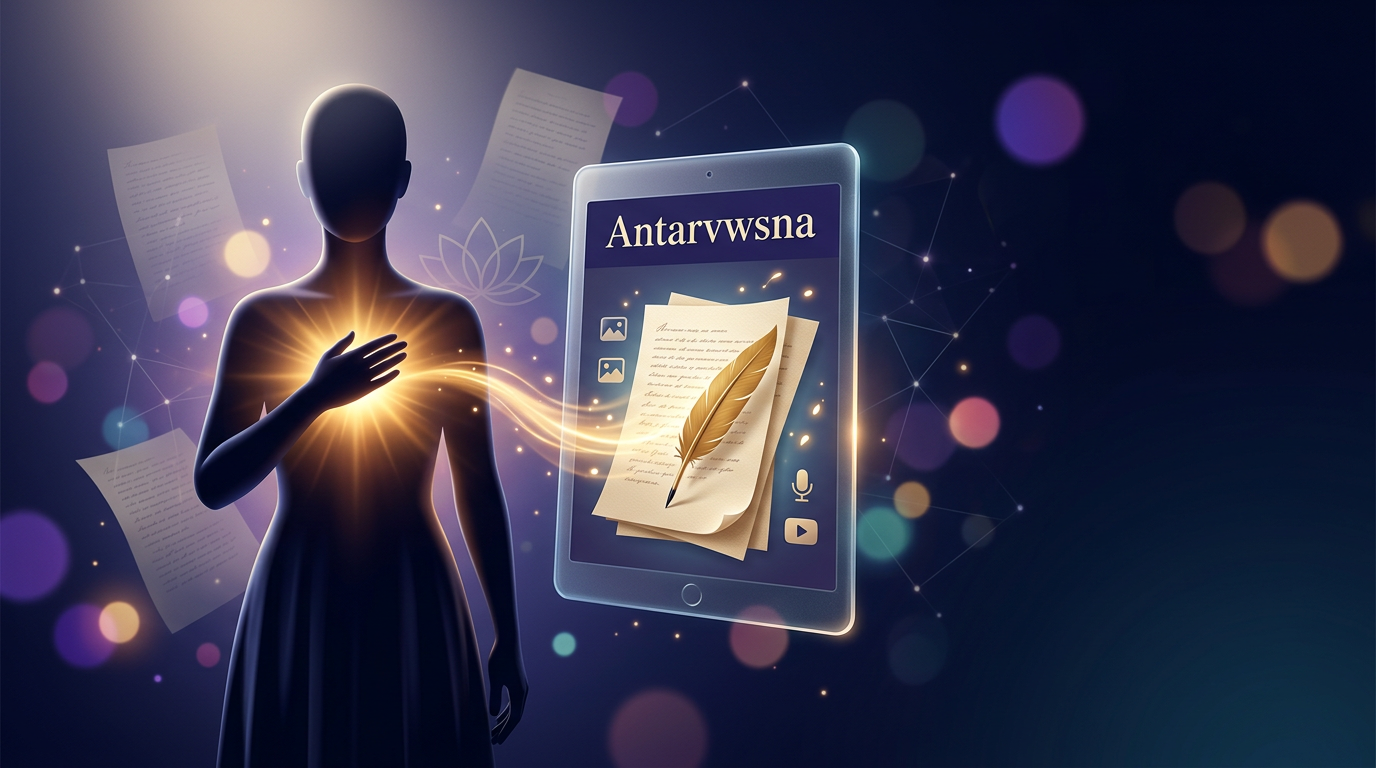
If you searched antarvwsna, you probably noticed something unusual. The word looks slightly off from standard dictionary spellings, yet it keeps appearing in philosophy blogs, self-help posts, and digital storytelling pages. Some writers treat it as pure psychology. Others describe a creative community. A few reduce it to sensational online fiction. The real picture is layered—and more interesting when you keep the layers separate.
Antarvwsna is best understood in two connected ways. First, it is a modern stylized spelling linked to the Sanskrit-derived idea of antarvasna / antar + vasana: inner desire, latent tendency, or unspoken longing. Second, it is also the name of a digital storytelling brand and website that presents itself as a hub for personal stories, fiction, and multimedia expression. Understanding which layer you need—concept or platform—is the key to using the term well.
This guide explains both layers carefully. You will get linguistic roots, psychological parallels, cultural context, platform features as publicly described, benefits and risks of inward-facing reflection, common mistakes, and practical ways to engage with the idea without hype or confusion.
Quick Answer: What Antarvwsna Means
At the language level, antarvwsna is widely treated as a digital-era spelling of a South Asian-rooted phrase associated with inner desire or latent inner tendency. The first part, antar, points inward. The second part aligns with vasana / vāsanā, a classical term connected to mental impressions, inclinations, and desires that dwell in the mind. In other words, the keyword often names the private emotional currents that shape choices even when they are not spoken out loud.
At the product level, Antarvwsna is also presented publicly as a digital storytelling platform where users explore personal narratives, fiction, and multimedia-style creative expression. The official site describes a community-oriented space for authentic storytelling, collaboration, and cross-cultural connection, and it also surfaces AI-assisted story generation tools in multiple languages.
Those two layers explain the search chaos. One person wants philosophy. Another wants a writing community. A third wants emotional vocabulary for private feelings. All three may type the same word.
For a grounded introduction to the classical idea behind vāsanā (latent impressions and tendencies), see the overview of Vāsanā on Wikipedia. For broader context on how people share identity and narrative online, the overview of internet culture is useful. Ongoing technology and culture reporting from the BBC Technology section helps frame how digital platforms reshape expression.
Quick Facts Table
| Field | Details |
|---|---|
| Primary Keyword | antarvwsna |
| Related Standard Forms | Antarvasna / Antar + Vasana / Vāsanā-related usage |
| Core Conceptual Meaning | Inner desire, latent inclination, unspoken longing, internal emotional current |
| Linguistic Roots | Antar (inner/within) + Vasana/Vāsanā (desire, inclination, latent mental impression) |
| Modern Digital Role | Keyword, cultural concept, and brand/platform name |
| Platform Identity (public) | Digital storytelling hub at antarvwsna.com |
| Platform Content Focus (public) | Personal stories, fiction, multimedia-style creative content, community interaction |
| Public Tooling Signal | AI-assisted story generation in English, Urdu, and Hindi mentioned on site materials |
| Owner / Founders | Detailed verified corporate biographies Not Publicly Available |
| Headquarters | Not Publicly Available |
| Founding Date | Exact independent founding dossier Not Publicly Available |
| Net Worth / Valuation | Not Publicly Available |
| Awards | Not Publicly Available |
| Best For | Readers exploring inner-life vocabulary; creators seeking story-sharing context |
| Not Best For | Anyone seeking clinical diagnosis tools, guaranteed spiritual systems, or fully transparent corporate filings |
| Important Caution | Some online uses drift into adult or sensational content ecosystems; evaluate sources carefully |
Because antarvwsna is a concept and brand term—not a celebrity—classic personal biography fields do not apply. Where ownership details are thin, they are marked Not Publicly Available.
Why People Search for Antarvwsna
Curiosity is the first driver. The spelling looks rare, almost coded, which makes people stop and investigate.
Meaning-seeking is the second. Many readers want language for private feelings they cannot easily name: ambition that never got permission, affection that stayed quiet, creative hunger that keeps returning, restlessness that logic cannot fully explain.
Platform-seeking is the third. Some users encounter the word as a site or community name and want to know whether it is a story network, a blog, or something else.
A fourth driver is cultural translation. Words from Indic linguistic and philosophical traditions often travel into English internet culture with new spellings and looser meanings. Searchers want the bridge between classical sense and modern use.
Finally, digital storytelling trends amplify the term. Personal narrative, anonymous confession culture, serialized fiction, and AI writing tools all create demand for emotional keywords that feel intimate rather than corporate.
Linguistic Roots and Correct Understanding
Antar + Vasana
Break the idea into parts and it becomes clearer.
| Element | Approximate Sense | What It Contributes |
|---|---|---|
| Antar | Inner, within, internal | Points to the private interior life |
| Vasana / Vāsanā | Desire, inclination, latent impression | Points to tendencies that dwell in the mind |
| Combined sense | Inner desire / latent inner longing | Names unspoken internal drivers |
In classical usage, vāsanā is not always a simple synonym for “wanting ice cream.” It often points to deeper residual impressions—tendencies formed by experience that quietly shape attention, craving, habit, and reaction. That is why the term can sound philosophical rather than casual.
A careful modern reading of antarvwsna should keep that depth. It can include romantic longing, yes. It can also include creative drive, spiritual hunger, social ambition, the wish to be understood, or the urge to leave a life that no longer fits.
Why the Spelling Looks Different Online
Standardized academic spellings usually prefer forms closer to antarvasna or discussions of vāsanā. The version antarvwsna is widely treated as a stylized digital spelling. Online communities often alter vowels and consonants for uniqueness, branding, search distinctiveness, or filter navigation. Over time, the altered form becomes a keyword identity of its own.
That does not make the stylized spelling “fake.” It means the internet created a variant. Smart readers track both the classical root and the modern wrapper.
Philosophical and Cultural Context
In many South Asian reflective traditions, the inner life is not a side project. Desire, restraint, duty, memory, and liberation are treated as serious forces. Latent tendencies matter because they influence action even when a person believes they are choosing freely.
In literature and cinema from the region, unspoken longing is a familiar dramatic engine: characters want love, freedom, recognition, or truth, yet social scripts pressure them to stay silent. The emotional tension between interior wish and exterior role is exactly the territory antarvwsna points toward in cultural conversation.
This is also why the term can feel broader than a single emotion. It can describe the quiet script beneath behavior. Two people may look calm in public while carrying very different private weather systems. One carries grief. Another carries ambition. Another carries a creative project that never found time. Naming that interior weather can be the first step toward honesty.
For broader cultural and media context on how societies discuss identity and expression, high-authority reporting from the BBC remains useful beyond keyword-driven blogs.
Psychological Parallels Without Overclaiming
Modern psychology does not need the exact word antarvwsna to recognize similar territory. Subconscious patterns, suppressed emotion, intrinsic motivation, and habit loops all describe forces that operate partly outside immediate awareness.
Useful parallels include:
| Modern Lens | Overlap With Antarvwsna | Healthy Use |
|---|---|---|
| Subconscious patterns | Hidden drivers of repeated choices | Notice loops without self-attack |
| Suppressed emotion | Feelings kept private under social pressure | Name feelings safely |
| Intrinsic motivation | Inner pull toward meaningful activity | Align goals with real interest |
| Habit formation | Repeated tendencies that “run themselves” | Redesign cues and routines |
| Self-reflection | Looking inward with curiosity | Convert insight into small action |
Important boundary: antarvwsna is not a clinical diagnosis. It is not a substitute for therapy, psychiatry, or crisis care. If emotional distress is intense, persistent, or unsafe, professional support matters more than any keyword essay.
A practical psychological reading is simple. Inner desire is information. It is not automatically an order you must obey, and it is not automatically a shame you must bury. The skill is discernment.
Antarvwsna as a Digital Storytelling Platform
What the Platform Claims to Offer
Public materials on antarvwsna.com describe Antarvwsna as a digital storytelling platform for personal experiences, fictional tales, and multimedia content. The positioning emphasizes authenticity, community interaction, creative freedom, and a space where diverse voices can share narratives.
The site also presents an “AI Story Weaver” style experience, promoting generation of longer stories from keywords or short prompts in English, Urdu, and Hindi. That signals a hybrid identity: partly community storytelling brand, partly AI-assisted creative tool layer.
Content Types
According to public platform descriptions, content can include:
| Content Type | What It Looks Like in Practice |
|---|---|
| Personal stories | Life experiences, reflections, emotional journeys |
| Fiction | Romance, drama, fantasy, thriller-style narratives |
| Informative posts | Broader topical writing mixed into the ecosystem |
| Multimedia | Images, visual storytelling, richer media formats |
| Collaborative projects | Shared series, challenges, community events |
Community and Creative Positioning
The brand language stresses inclusion, low judgment, and the freedom to explore sensitive or niche topics. That is attractive for writers who feel squeezed by polished social media performance culture. It also creates moderation challenges. Any community that invites raw personal narrative must balance openness with safety, consent, and clear boundaries.
Independent ownership dossiers, audited user counts, and formal corporate histories remain largely Not Publicly Available. Evaluate the live site, terms, and your own comfort level rather than relying on recycled marketing claims alone.
How the Concept Shows Up in Modern Digital Culture
Digital culture loves interior language. Confessional essays, anonymous forums, therapy-speak on social media, and serialized fiction all feed a hunger for emotional honesty. Antarvwsna fits that climate because it sounds intimate and interior.
At the same time, stylized spellings can attract low-quality content farms that use the mystery of the word to generate interchangeable articles. Some pages inflate it into a complete spiritual operating system. Others collapse it into pure sensationalism. The mature approach is narrower and cleaner:
| Healthy Digital Use | Low-Quality Digital Use |
|---|---|
| Naming private feelings with care | Claiming one word solves every life problem |
| Writing reflective fiction or memoir | Exploiting curiosity with misleading clickbait |
| Discussing culture and psychology thoughtfully | Ignoring consent, privacy, or emotional safety |
| Using AI tools as drafts, then editing | Publishing unexamined AI sludge as wisdom |
Storytelling itself remains one of humanity’s oldest technologies for processing desire and conflict. For background on narrative as a cultural form, the overview of storytelling on Wikipedia is a strong high-authority companion.
Benefits of Working With Inner Desire Consciously
The first benefit is vocabulary. Many people suffer twice: once from the feeling, and again from not knowing how to name it.
The second benefit is pattern recognition. When you track recurring longings, you stop treating every mood as random weather.
The third benefit is better decisions. Career changes, creative projects, and relationship boundaries become clearer when you can distinguish deep desire from temporary impulse.
The fourth benefit is creative fuel. Fiction, poetry, essays, and art often begin in the gap between what is lived and what is longed for.
The fifth benefit is compassion. Understanding your own hidden pressures can make other people’s contradictions less shocking.
The sixth benefit is integration. Instead of living a split life—public mask, private storm—you can slowly bring values and actions into closer alignment.
Drawbacks, Risks, and Misuses
Romanticizing every inner urge is dangerous. Not every desire deserves action. Some urges are trauma echoes, habit leftovers, or socially borrowed cravings.
Over-identifying with longing can stall life. Endless introspection without behavior change becomes a maze.
Cultural stigma can make people feel broken for having interior conflict. The point of the concept is understanding, not self-condemnation.
Online, the keyword can sit near mature or sensational content ecosystems. Readers should use source judgment, privacy settings, and age-appropriate boundaries.
AI story tools can flatten nuance. A generated tale may sound emotional while remaining generic. Human editing and ethical judgment still matter.
Spiritual bypassing is another risk: using mystical language to avoid practical responsibilities, therapy, or difficult conversations.
Pros vs Cons Table
| Potential Value | Corresponding Limitation |
|---|---|
| Rich language for inner life | Easy to over-mystify ordinary feelings |
| Bridge between culture and psychology | Not a clinical framework |
| Creative inspiration for writers | Can attract low-quality content farming |
| Platform space for storytelling | Ownership/transparency details limited publicly |
| Encourages self-reflection | Reflection without action can stall growth |
| Multilingual creative tooling signals | AI output quality varies and needs review |
Antarvwsna vs Related Ideas and Platforms
| Idea or Platform | Core Focus | How Antarvwsna Relates |
|---|---|---|
| Vāsanā (classical) | Latent impressions and tendencies | Closest philosophical root |
| Intuition | Fast inner knowing | Overlaps, but antarvwsna is broader than snap insight |
| Shadow work (popular psychology) | Integrating disowned parts of self | Similar honesty goal, different vocabulary |
| Medium | Long-form publishing | More essay/media oriented than community fiction-first |
| Wattpad-style networks | Serialized fiction communities | Closer competitor in story-sharing energy |
| Journaling apps | Private reflection | Antarvwsna concept can feed journaling; platform is more public/creative |
| Generic self-help brands | Habit and productivity systems | Antarvwsna is more about desire literacy than task systems |
No single comparison captures every use. Context decides whether you are talking philosophy, psychology-adjacent reflection, or a website brand.
Practical Ways to Explore the Concept Responsibly
Start with naming, not dramatizing. Write one sentence: “The longing I keep returning to is ___.”
Separate desire from demand. “I want creative work” is information. “I must quit everything tomorrow” is a strategy claim that needs testing.
Use a simple three-column note:
| Desire I Notice | Evidence It Is Recurring | One Small Ethical Next Step |
|---|---|---|
| More creative time | Envy when friends publish | 25-minute draft block thrice a week |
| Deeper friendship | Loneliness after social media | One honest check-in message |
| Career change | Sunday dread pattern | Informational interview, not sudden resignation |
If you write fiction inspired by antarvwsna, protect real people. Change identifiers. Avoid weaponizing private confessions.
If you use AI story tools, treat output as clay, not scripture. Edit for voice, consent, cultural respect, and emotional accuracy.
If feelings become overwhelming, pair reflection with support from trusted humans or licensed professionals.
Common Mistakes People Make
One mistake is assuming one rigid dictionary definition ends the conversation. The term travels across philosophy, psychology-adjacent writing, and platform branding.
Another mistake is collapsing all inner desire into only one category of longing. The interior life is wider than that.
A third mistake is confusing insight with transformation. Knowing your pattern is step one. Changing the conditions that feed it is step two.
A fourth mistake is outsourcing self-knowledge to viral posts. Algorithms reward intensity, not accuracy.
A fifth mistake is ignoring ethics in storytelling. Personal narrative shared publicly can affect families, partners, and communities.
A sixth mistake is treating stylized spelling debates as more important than lived clarity. Whether you write antarvwsna or a standard variant, the useful question is still: what interior truth am I trying to understand?
Best Practices for Readers and Creators
Read slowly when the topic is emotional. Speed-reading desire essays often creates false certainty.
Prefer sources that admit complexity. Distrust pages that promise total liberation in five steps.
Keep a private journal layer even if you also publish. Not every insight needs an audience.
When using the platform side of antarvwsna, review community norms, privacy settings, and what you are comfortable attaching to your name or pseudonym.
Give feedback to your own stories after a cooling-off period. First drafts of emotional writing are often heat without form.
Balance interior work with exterior care: sleep, friendships, finances, and physical health. Inner desire grows wiser in a stable life.
If you teach or write about the concept, credit the broader cultural and linguistic roots rather than pretending the internet invented inwardness.
Decision Checklist: Concept, Platform, or Something Else?
| If you need… | Go here | Avoid |
|---|---|---|
| Linguistic/philosophical meaning | Antar + vasana explanation and classical context | One-line hype definitions |
| Emotional self-reflection tools | Journaling, therapy-adjacent practices, honest conversation | Endless doom-scrolling “meaning” posts |
| A place to read/write stories | Storytelling platforms including Antarvwsna’s public site | Unvetted sites that pressure unsafe sharing |
| Clinical mental health care | Licensed professionals and crisis resources | Treating a keyword as treatment |
| Creative prompting | AI or human brainstorming with strong editing | Publishing raw machine text as deep wisdom |
Expert Insights on Language, Desire, and Online Meaning
From an experience standpoint, people usually search words like antarvwsna when ordinary vocabulary feels too thin. “I am stressed” does not capture the ache of an unlived life. “I am fine” does not capture the pressure of a silenced wish. New or revived terms spread because they offer a handle.
Expertise in this territory means holding two truths at once. Interior desire is powerful. Interior desire is not automatically wise. Cultures that only suppress longing create shadow lives. Cultures that only glorify impulse create chaos. Mature practice sits between those poles.
Authoritativeness online is earned by precision. Pages that clearly separate classical roots, psychological parallels, and platform branding help readers more than pages that blend everything into mystical fog.
Trust is the final layer. Trustworthy writing about private emotion respects consent, avoids exploitation, and refuses to pathologize normal human complexity. It also refuses to sell false certainty. The inner life is not a product bundle.
Digital storytelling can support that trust when communities moderate well and creators take responsibility for what they publish. It fails when curiosity is used as bait.
Conclusion
Antarvwsna sits at the crossroads of language, interior life, and digital culture. As a concept, it points toward inner desire and latent emotional tendency—the private currents that shape ambition, attachment, creativity, and restlessness. As a modern web presence, it also names a storytelling-oriented platform identity where personal and fictional narratives can be shared and generated.
Kept clear, the word is useful. It gives people language for what they already feel. Kept muddy, it becomes either empty mysticism or sensational clickbait.
If this guide helped you, choose your next step with intention. If you came for meaning, journal one recurring longing and one ethical action. If you came for storytelling, read widely, write honestly, and protect consent. If emotional weight feels heavy, bring a trusted person or professional into the process. Inner life matters—and it deserves clarity, not confusion.
Frequently Asked Questions
1. What is antarvwsna in simple words?
Antarvwsna generally refers to inner desire or latent inner longing—the private emotional and psychological currents that influence thoughts and choices. Many writers treat it as a stylized form connected to antar (inner) and vasana (desire/tendency). In modern internet use, it can also refer to a digital storytelling brand or platform. The exact sense depends on whether the context is philosophical, psychological-adjacent, or website-related.
2. Is antarvwsna a real Sanskrit word in that exact spelling?
The most careful answer is that antarvwsna is a modern stylized spelling tied to Sanskrit-derived components rather than the only academic transliteration. Discussions usually connect it to antar + vasana/vāsanā. Classical sources and encyclopedic references are stronger around vāsanā as latent impression or inclination. Online culture then reshapes spelling for branding and search identity.
3. What is the difference between antarvwsna and ordinary wanting?
Ordinary wanting can be situational and short-lived. The deeper sense associated with this term points to recurring interior tendencies—longings and impressions that return over time and shape identity. A craving for a snack is simple. A years-long pull toward a different creative life, relationship pattern, or spiritual direction sits closer to the richer meaning people seek under antarvwsna.
4. Is antarvwsna only about romantic or adult desire?
No. While some online ecosystems emphasize that angle, the broader linguistic and philosophical territory includes many forms of inner inclination: creative, emotional, material, relational, and spiritual. Reducing the whole concept to one narrow category misses the wider human pattern of unspoken motivation. Always judge the specific source you are reading.
5. What is the Antarvwsna website?
Public materials describe Antarvwsna as a digital storytelling platform for personal stories, fiction, and multimedia content, with community interaction and creative expression as core themes. The site also presents AI-assisted story generation in multiple languages. Detailed independent corporate ownership data remains largely Not Publicly Available, so users should review the live site and terms directly.
6. Is antarvwsna a religion or a therapy method?
It is not a formal religion, and it is not a licensed therapy protocol. People use the term in cultural, reflective, and creative ways. You can borrow its vocabulary for self-inquiry, journaling, or storytelling without joining a system. If you need mental health treatment, turn to qualified professionals rather than keyword essays or anonymous posts.
7. How is antarvwsna connected to psychology?
Psychology studies motivation, emotion, habit, and the parts of mental life outside full awareness. That overlaps with the idea of latent desires and interior patterns. Useful bridges include intrinsic motivation, suppressed emotion, and repetitive behavioral loops. The connection is conceptual, not a claim that antarvwsna is a validated clinical term in mainstream diagnostic manuals.
8. Why is the spelling often strange or inconsistent?
Internet language evolves quickly. Users modify spellings for uniqueness, brand identity, transliteration differences, or to navigate content filters. As a result, one concept can appear in several forms. When researching, compare variants and look for explanations that include linguistic roots, not only repeated hype paragraphs.
9. Can exploring antarvwsna improve creativity?
Yes, for many people. Unspoken longing is classic creative fuel. Writers and artists often transform private tension into character, image, and plot. The healthy version uses desire as material for art and insight. The unhealthy version confuses intensity with quality and publishes unprocessed emotion without craft or care for others involved.
10. What are the risks of focusing too much on inner desire?
Risks include overthinking, impulsive decisions, spiritual bypassing, and neglecting practical responsibilities. Another risk is online exposure: sharing highly personal material can have social or privacy consequences. Balance interior curiosity with sleep, relationships, work realities, and, when needed, professional support. Insight should make life more workable, not more chaotic.
11. How can I practice the idea in daily life?
Keep it concrete. Once a day, write down one recurring longing and one evidence cue that it is real. Weekly, choose one small ethical action that honors the longing without burning your life down. Monthly, review whether your actions reduced inner conflict or increased drama. This turns a poetic word into a disciplined reflection habit.
12. Is AI storytelling compatible with antarvwsna?
It can be, if used as a draft assistant. AI can help generate plot seeds or multilingual text quickly. It cannot feel your life for you. The authentic core of antarvwsna—lived interior truth—still requires human memory, judgment, editing, and ethical boundaries. Use tools; do not outsource self-knowledge.
13. How does antarvwsna differ from intuition?
Intuition is often described as rapid knowing. The broader antarvwsna territory includes slower, layered longings and latent tendencies that unfold over time. You might intuit danger in a second. You might carry a creative or relational longing for years. Both are interior, but they operate on different tempos and should be tested differently.
14. Why do some articles disagree so strongly about the meaning?
Because the keyword sits at an intersection of classical language, popular psychology, digital branding, and uneven content marketing. Some writers emphasize philosophy. Others emphasize platforms. Others chase traffic with dramatic claims. Disagreement shrinks when authors separate roots, modern usage, and commercial identity instead of blending them into one foggy definition.
15. What is the smartest way to use this antarvwsna guide?
Decide your lane first. If you want meaning, focus on linguistic and reflective sections. If you want storytelling, evaluate platforms and creative practices. If you are in emotional distress, prioritize support over semantics. Use the word as a lantern, not as a cage—something that helps you see your interior life more clearly, then act with care.




Leave a Reply