
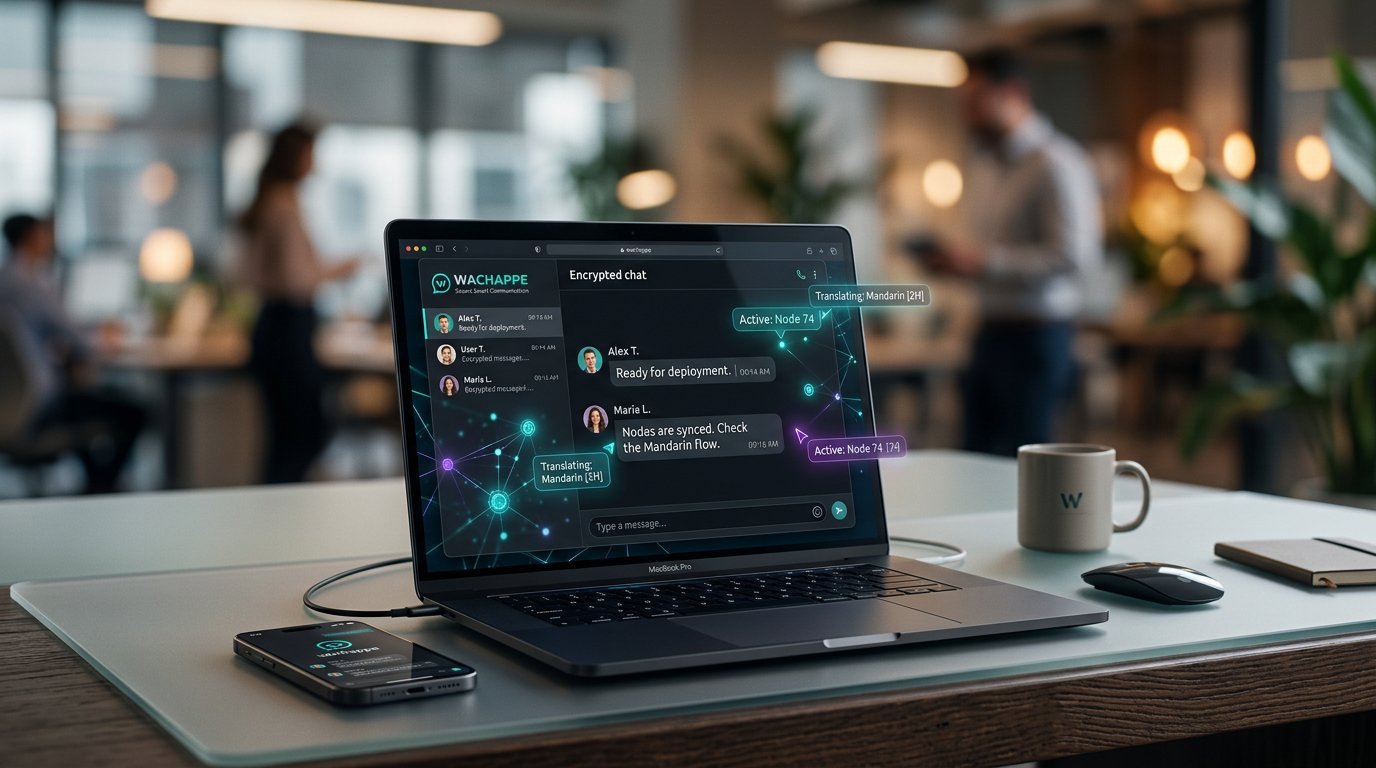
The digital landscape is undergoing a massive transformation in how people connect, collaborate, and exchange information across virtual networks. If you have recently encountered the term wachappe across tech discussions, social channels, or messaging forums, you are observing a fascinating blend of linguistic evolution and modern software innovation. At its core, wachappe represents both a popular phonetic expression derived from informal digital greetings and a broader framework for next-generation, cloud-based communication ecosystems. Modern internet users increasingly demand platforms that seamlessly unify text messaging, high-definition voice and video calling, intelligent automation, and absolute cryptographic privacy into a singular, frictionless experience. By bridging the gap between casual conversational slang and advanced artificial intelligence tools, wachappe has captured the attention of privacy enthusiasts, digital nomads, and forward-thinking enterprises alike. Understanding this concept requires looking past basic text transmission and examining how smart software architecture can restore context, emotion, and productivity to remote human interactions. As software models advance, the shift toward user-centric control is reshaping expectations across all digital media formats.
Understanding Wachappe: Etymology, Definition, and Cultural Context
To fully grasp what makes wachappe such a widely discussed subject in contemporary tech discourse, one must first explore its fascinating dual origin story. The term initially emerged within informal online communities as an energetic, phonetic rendering of everyday phrases like “what’s up,” “watcha up to,” and “WhatsApp.” Over time, as digital chat cultures expanded worldwide, internet users began employing the expression both as a friendly greeting and as a general shorthand for modern instant messaging habits. When someone asks “wachappe?” in a group chat or message thread, they are simultaneously checking in on your current activity and inviting you into a shared virtual space. This organic linguistic drift highlights how digital culture constantly reshapes human vocabulary to keep pace with rapid technological shifts. Observing these shifts provides crucial context for how internet-native vernacular becomes codified over time.
Beyond its stylistic root as an informal online greeting, wachappe has evolved into a conceptual model for holistic, next-generation communication environments. Rather than viewing text messaging as an isolated utility, the wachappe framework emphasizes an interconnected digital ecosystem where media sharing, context-aware artificial intelligence, and collaborative workspaces operate harmoniously. In this modern context, the focus shifts away from basic message delivery toward active comprehension, user privacy, and cross-platform flexibility. The term encapsulates a paradigm shift where users no longer adapt to rigid software constraints, but rather utilize software that adapts intuitively to human communication patterns. By marrying casual conversational warmth with sophisticated infrastructure, this concept establishes a fresh standard for how virtual dialogues should function in an interconnected world. Ultimately, this approach dismantles traditional friction points between personal expressiveness and enterprise security.
The Linguistic Evolution from Slang to Tech Term
Linguistic transformation on the internet happens at a staggering pace, often fueled by global social networks, short-form video content, and voice notes. The journey of wachappe from spoken colloquialism to a recognized digital search term illustrates how online communities adapt language for maximum efficiency and expression. Early adopters frequently typed the phrase phonetically in casual chatrooms, fusing casual English greetings with recognizable mobile software titles. As search engines and social algorithms recorded thousands of user queries searching for instant messaging troubleshooting, download links, and chat tips under varied spellings, the keyword solidified its position in digital lexicon. Today, language scholars and technology analysts monitor such terminology to evaluate broader shifts in how younger generations perceive and utilize mobile software platforms. These ongoing shifts reveal how organic vocabulary can drive structural changes across digital software development.
The Dual Identity: Phrase vs. Modern Communication Framework
Navigating modern tech discussions requires acknowledging that terms often hold multiple meanings depending on the context in which they appear. On one hand, wachappe serves as an approachable, lighthearted greeting used across messaging applications to initiate conversations and build rapport among friends. On the other hand, tech strategists and software designers use the term to describe an idealized, all-in-one digital hub that eliminates the clutter of fragmented single-purpose utilities. Recognizing this dual identity enables users to appreciate both the social nuances of digital chatter and the underlying technological trends reshaping modern software design. Whether you view it as a friendly salutation or a blueprint for future chat apps, the underlying emphasis remains firmly centered on connection, clarity, and ease of use. This dual nature ensures that the term resonates equally well in informal personal chats and technical planning sessions.
The Historical Evolution of Digital Messaging
Understanding the emergence of concepts like wachappe requires reviewing the historical trajectory of personal and enterprise telecommunications over the past three decades. Digital messaging has evolved through distinct technological epochs, each solving specific limitations of the previous generation while introducing higher bandwidth, richer features, and greater accessibility. By examining this historical progression, we can appreciate why modern users demand far more than basic text delivery from their daily communication software. The journey from restricted alphanumeric displays to real-time AI assistance reflects humanity’s unyielding desire for frictionless, high-fidelity interaction across physical distances. Each evolutionary milestone laid the groundwork for modern cryptographic protocols and cloud state synchronizations.
| Era / Generation | Core Technologies | Primary Limitations | User Experience Paradigm |
|---|---|---|---|
| Stage 1 (1990s) | Basic SMS, Cellular Towers, Alphanumeric Pagers | 160-character limits, high carrier fees, text only | Asynchronous, basic text utility |
| Stage 2 (2000s) | MMS, Early Mobile Web, Instant Messengers (AIM, MSN) | Desktop tethering, compression artifacts, fragmented networks | PC-based online presence, buddy lists |
| Stage 3 (2010s) | Cloud Chat Apps, 3G/4G Networks, App Stores | Privacy vulnerabilities, monetization tracking, platform lock-in | Mobile-first instant messaging, emoji, group chats |
| Stage 4 (2020s+) | AI-Enhanced Systems, End-to-End Encryption, Multi-Device Sync | Network fragmentation, digital fatigue, notification overload | Contextual hubs, privacy sovereignty, proactive workflow assistance |
Stage 1: Standard SMS and Carrier-Bound Texting
During the early days of mobile telecommunications, Short Message Service (SMS) established the foundation for digital text delivery. Operating over traditional cellular signaling channels, SMS allowed users to transmit short, 160-character messages directly between wireless handsets without needing internet access. Although groundbreaking at the time, SMS was severely constrained by expensive per-message pricing models, lack of international routing standardization, and zero support for media files or group conversations. Moreover, SMS messages traveled in unencrypted plain text across carrier networks, leaving user conversations vulnerable to interception and spoofing. Despite these fundamental limitations, SMS proved that mobile users favored instant written connection over formal voice calls. This early consumer adoption set off a multi-decade wave of telecommunication innovation that transformed global communications.
Stage 2: Rich Multimedia Services (MMS) and Basic Web Messaging
As mobile networks upgraded to 2.5G and 3G standards, telecom operators introduced Multimedia Messaging Service (MMS) to allow photo, video, and audio file transfers. Concurrently, desktop-based instant messaging clients gained massive global popularity, introducing real-time status indicators, custom avatars, and rich file sharing over internet protocols. However, mobile MMS remained notoriously expensive, unreliable across competing cellular carriers, and subject to aggressive media compression that rendered images blurry and low-resolution. Meanwhile, desktop clients lacked true mobile continuity, forcing users to remain seated at personal computers to maintain continuous discussions. These friction points signaled an urgent market requirement for unified, internet-native messaging protocols. The industry quickly realized that hardware-dependent messaging was incapable of supporting dynamic modern lifestyles.
Stage 3: Centralized Cloud-Based Chat Applications
The rollout of smartphones, high-speed 4G broadband, and centralized app distribution platforms transformed mobile messaging into a global phenomenon. Mobile applications capitalized on IP-based routing, bypassing legacy telecommunication fees entirely to provide unlimited global messaging, voice calling, and high-definition photo sharing over Wi-Fi and mobile data. Industry leaders established massive network effects by leveraging smartphone contact lists, enabling instant connectivity without requiring complex usernames or manual buddy requests. To explore the broader technical history of these platforms, readers can consult Wikipedia’s detailed history of instant messaging for an in-depth chronological breakdown. However, as these platforms grew into tech giants, concerns regarding centralized data tracking, targeted advertising, and surveillance models began to alienate privacy-conscious consumers. This growing dissatisfaction set the stage for privacy-first architecture.
Stage 4: AI-Enhanced, Privacy-First Smart Communication Hubs
We have officially entered the fourth generation of digital interaction, where privacy rights and artificial intelligence intersect to redefine communication software. The modern paradigm embodied by wachappe prioritizes absolute cryptographic privacy as a baseline requirement while layering intelligent software capabilities directly on top of secure channels. Modern communication hubs do not merely deliver packets; they actively analyze context, summarize complex discussion threads, translate languages in real time, and eliminate cross-device synchronization latency. By decentralizing key management and running machine learning models locally on hardware, contemporary tools deliver remarkable productivity features without compromising individual user confidentiality. This evolutionary peak ensures that personal conversations remain genuinely private while empowering users with world-class productivity utilities. Modern technological design now treats personal privacy and user convenience as complementary goals rather than competing trade-offs.
Core Features and Architecture of the Wachappe Ecosystem
The architecture supporting modern platforms like wachappe rests on several technological pillars designed to solve real-world communication bottlenecks. Instead of treating features as isolated add-ons, the platform integrates security, intelligence, and interface design into a seamless unified engine. Users benefit from an environment where complex cryptographic key exchanges and machine learning models operate quietly in the background without hindering rapid typing or media transmission. Understanding these core features reveals why users are rapidly transitioning away from legacy, ad-supported messaging clients toward intelligent digital hubs. Each architectural component works in unison to reduce latency, boost visual fidelity, and enforce strict zero-knowledge security standards.
Intelligent Context Analysis and Real-Time Translation
Language barriers and contextual misunderstandings remain two of the biggest hurdles in global communication today. Within the wachappe paradigm, integrated artificial intelligence evaluates incoming messages in real time to offer accurate translations, suggested responses, and tone adjustments tailored to specific cultural contexts. For example, if an international partner sends a complex project update in Japanese, the application translates the text instantly while preserving industry-specific technical terms. Furthermore, the system detects emotional tone and urgency, allowing users to catch critical updates even when skimming through bustling group conversations. This contextual intelligence reduces friction, prevents misunderstandings, and fosters seamless collaboration across diverse geographic regions. Consequently, cross-cultural communication becomes far more direct, accurate, and empathetic.
Zero-Knowledge Cryptography and End-to-End Encryption
Security is not merely a feature within modern digital ecosystems; it is the fundamental foundation upon which trust is constructed. Under the cryptographic architecture championed by wachappe, all text messages, voice recordings, video streams, and media attachments undergo end-to-end encryption prior to leaving the user’s local device. This cryptographic construction ensures that encryption keys are generated and stored exclusively on client endpoints, rendering server infrastructure entirely incapable of reading, decrypting, or monetizing user content. To better understand how modern cryptography secures electronic interactions, review the technical frameworks detailed on Wikipedia’s end-to-end encryption resource. This zero-knowledge approach guarantees that even in the event of server compromises or legal requests, unauthorized third parties encounter only unreadable, high-entropy cipher text. Protecting user integrity at the mathematical layer ensures long-term resistance against emerging cyber threats.
Unified Multi-Device Synchronization Across Operating Systems
Modern users routinely transition between smartphones, tablets, laptops, and desktop workstations throughout their daily workflows. The wachappe ecosystem utilizes advanced cloud synchronization state engines that maintain bit-for-bit consistency across all registered endpoints without requiring an active primary smartphone connection. If you compose a message draft on a desktop computer, answer a voice call on a tablet, and archive an existing thread on a mobile device, state changes propagate instantaneously across all active hardware instances. Crucially, this state synchronization occurs through re-encrypted ephemeral relays, preserving rigorous cryptographic protection regardless of screen size or operating system. As a result, users experience total hardware flexibility without risking message dropouts, duplicate notification spam, or compromised encryption streams. Unbroken multi-device connectivity eliminates hardware boundaries in modern professional workflows.
Original-Quality Media Sharing and Workspace Collaboration
Legacy chat applications frequently degrade shared photos and videos through harsh lossy compression algorithms, frustrating creative professionals and high-resolution media enthusiasts. The wachappe operational model solves this nuisance by enabling direct point-to-point file transfers that retain original metadata, RAW camera detail, and uncompressed audio formats up to generous file limits. Furthermore, collaborative workspaces within the application allow team members to view, annotate, and co-edit documents natively inside the active chat window. By eliminating the constant need to upload files to external third-party cloud storage drives, teams keep project assets consolidated within secure, searchable conversation channels. This media fidelity ensures that graphic designers, photographers, software developers, and executive teams maintain precise quality standards during virtual interactions. Streamlining asset management drastically reduces creative turnaround times for remote teams.
Wachappe vs. Traditional Messaging Platforms: A Detailed Comparison
Selecting the right communication tool requires evaluating how modern solutions compare against established market leaders across essential functional parameters. While traditional messaging utilities served the market adequately during the early smartphone era, their business models and underlying codebases often lag behind modern privacy standards and AI integrations. The comprehensive comparison matrix below highlights how the wachappe concept stacks up against conventional messaging solutions in privacy, intelligence, and overall utility. Examining these metrics side by side clarifies why legacy applications often feel restrictive for power users. This analytical evaluation gives users clear clarity when auditing their communication tools.
| Capability / Feature | Wachappe Concept | WhatsApp (Meta) | Telegram | Signal |
|---|---|---|---|---|
| Default End-to-End Encryption | Yes (Across all media/chats) | Yes (Signal Protocol based) | No (Optional secret chats only) | Yes (Gold standard protocol) |
| Integrated AI Translation & Summarization | Native & Local On-Device | Limited / Cloud Third-Party | Bot-Based Extensions | None (By design for minimal footprint) |
| Original Quality Media Transfers | Supported natively | Highly compressed by default | Supported (Up to 2GB) | Compressed by default |
| Multi-Device Independence | Independent client sync | Dependent on primary phone link | Independent client sync | Linked secondary clients |
| Ad Tracking & Data Harvesting | Zero metadata monetization | Comprehensive profile building | Optional ad platform in channels | Zero commercial tracking |
| Maximum Group Capacity | 500+ High-Performance | 1,024 Members | 200,000 Members | 1,000 Members |
Direct Comparison: Wachappe vs. WhatsApp
While WhatsApp remains a dominant force in global consumer messaging due to historical market dominance, its operational framework exhibits notable friction points for power users. WhatsApp relies heavily on centralized metadata collection to fuel broader advertising algorithms across its parent company’s ecosystem, raising ongoing privacy concerns among security experts. Conversely, wachappe emphasizes absolute metadata minimization, ensuring that non-content telemetry like contact graphs, IP connection timestamps, and device identifiers remain shielded from corporate analysis. Additionally, while WhatsApp compresses media files heavily to minimize server storage costs, wachappe offers uncompressed native transfers that preserve professional visual quality. Users seeking a balance between seamless usability and strict privacy safeguards find the modern wachappe architecture far superior for sensitive discussions. Choosing a platform designed around user sovereignty prevents long-term exposure to data harvesting pipelines.
Direct Comparison: Wachappe vs. Telegram and Signal
Comparing modern digital hubs against alternatives like Telegram and Signal illustrates distinct trade-offs in engineering philosophies. Telegram provides exceptional speed and rich group features, but its standard chats do not use default end-to-end encryption, storing conversations in cloud servers accessible to platform administrators. Signal, while providing benchmark cryptographic isolation, intentionally avoids advanced AI automation and complex productivity features to maintain an ultra-minimal codebase. Wachappe fills the crucial middle ground by delivering Signal-level cryptographic protections by default alongside Telegram-like features and cutting-edge artificial intelligence utilities. This hybrid philosophy delivers maximum technical capability without compromising user privacy, providing an ideal environment for both casual conversation and professional collaboration. Striking this precise technical equilibrium gives users the best of both security and functional flexibility.
System and Concept Snapshot
Because terms like wachappe exist at the intersection of popular digital culture, linguistic trends, and software paradigms rather than as a single proprietary entity owned by one corporation, summarizing its metadata requires a specialized contextual framework. The table below outlines the foundational specifications, terminology origins, and core characteristics associated with the term across current digital technology ecosystems. Reviewing these attributes offers a clear, structured overview of how the concept bridges informal online slang and enterprise-grade software capabilities. Software designers rely heavily on these structural benchmarks when conceptualizing next-generation user interfaces. This summary bridges conceptual theory with practical software specifications.
| Parameter | Specification / Attribute Details |
|---|---|
| Primary Classification | Digital Communication Concept & Emerging Messaging Paradigm |
| Etymological Roots | Phonetic derivative of “What’s up” combined with “WhatsApp” |
| Primary Target Audience | Tech-savvy consumers, remote professionals, privacy advocates |
| Core Architecture Focus | End-to-end cryptographic privacy, AI enhancement, multi-device agility |
| Supported File Protocols | Uncompressed binary streams, lossless audio, high-bitrate video |
| Data Collection Policy | Zero-knowledge design, minimal telemetry, zero ad-network profiling |
| Primary Access Vectors | Web clients, desktop native builds, iOS and Android mobile platforms |
| Community Perception | High trust, highly versatile, modern alternative to legacy ad-supported chat |
Practical Applications: Personal, Creative, and Enterprise Use Cases
The real-world value of any software technology stems from its ability to solve concrete challenges faced by individuals, creative teams, and business enterprises. The versatile nature of the wachappe framework allows it to seamlessly adapt to diverse social, professional, and operational environments without requiring cumbersome modifications. By examining specific deployment scenarios across personal life and commercial operations, we can understand why adoption rates continue to accelerate across tech-forward communities worldwide. Each practical implementation highlights how smart features directly enhance daily human efficiency and peace of mind. Adapting these workflows allows users across industries to maximize output while maintaining absolute data security.
Enhancing Casual Family and Social Connections
In everyday personal interactions, keeping extended family members, close friends, and interest groups connected requires an intuitive interface that removes technical complexity. Families using wachappe can effortlessly share high-resolution family photos, coordinate group gatherings, and send voice notes without worrying about cross-platform operating system incompatibilities. Integrated translation tools prove invaluable for multi-generational families residing across different countries, allowing grandparents and grandchildren to converse fluently despite language barriers. Furthermore, strict zero-knowledge privacy protections give parents peace of mind that personal photos of children remain safe from unauthorized commercial tracking or public automated collectors. Fostering warm personal ties across geographic boundaries becomes simple when technological friction is removed entirely.
Streamlining Remote Team Collaboration and Project Workflows
As modern businesses transition toward asynchronous, remote-first work cultures, traditional communication channels like email and fragmented chat channels often slow down execution. Teams leveraging the wachappe framework establish dedicated, encrypted project channels where engineers, designers, and marketers collaborate in real time. Built-in AI models assist by automatically summarizing lengthy chat logs, extracting action items from voice memos, and generating clean task summaries at the close of every workday. To monitor how emerging news and technological developments impact modern software infrastructure, professionals regularly consult respected outlets like BBC Technology News for trusted coverage. By centralizing real-time discussion and task tracking into one secure hub, remote organizations minimize costly status meetings and dramatically shorten project development cycles. Streamlined communication workflows give remote teams a decisive competitive advantage in fast-moving global markets.
Automating Customer Support for Emerging Businesses
For small businesses, e-commerce storefronts, and independent service providers, maintaining responsive customer service is vital for maintaining customer satisfaction and brand loyalty. Utilizing automated intelligent assistance within wachappe enables business owners to deploy responsive virtual agents capable of handling routine client inquiries twenty-four hours a day. These smart agents interpret natural language questions regarding inventory availability, order status tracking, and scheduling options, delivering instant, precise responses without human intervention. When complex inquiries arise, the system seamlessly transitions the discussion to a human specialist alongside a curated summary of the customer’s prior interaction history. This blend of automated efficiency and personalized human oversight enables small enterprises to deliver enterprise-grade support experiences at a fraction of traditional operational costs. Consistent, rapid support builds enduring customer relationships across competitive markets.
Architectural Deep Dive: Privacy Mechanics and Security Protocols
To fully appreciate the cryptographic integrity embedded within modern platforms like wachappe, one must examine the mathematics and software architecture securing user data. Privacy in the modern web cannot rely on simple password protection or corporate promises; it must be guaranteed by mathematical impossibility. By implementing state-of-the-art cryptographic primitives and zero-trust framework designs, these systems insulate user conversations against passive eavesdropping, malicious middleman attacks, and unauthorized server-side inspection. The flowchart below visually depicts how encrypted data payloads navigate client endpoints while remaining completely opaque to intermediate network relays. Modern security design mandates that client endpoints retain total authority over encryption keys.
text+-------------------------------------------------------------------+
|                     SENDER ENDPOINT DEVICE                        |
|  [ Plain Text Message ] -> Encrypted via Ephemeral Key (AES-256)  |
+-------------------------------------------------------------------+
                                  |
                                  v  (Encrypted Ciphertext Stream)
+-------------------------------------------------------------------+
|                      ZERO-KNOWLEDGE RELAY                         |
|    Acts strictly as a blind packet router. Cannot read or log     |
|                   message content or metadata.                     |
+-------------------------------------------------------------------+
                                  |
                                  v  (Encrypted Ciphertext Stream)
+-------------------------------------------------------------------+
|                    RECEIVER ENDPOINT DEVICE                       |
|  [ Encrypted Stream ] -> Decrypted via Private Endpoint Key       |
+-------------------------------------------------------------------+
The Physics of Default End-to-End Encryption
At the center of the wachappe security model is an advanced implementation of public-key cryptography combined with Double Ratchet key management protocols. When two endpoints initiate a conversation, their devices perform an automated cryptographic handshake to generate unique, ephemeral session keys. Every single message transmitted across the network receives a distinct, temporary encryption key that self-destructs immediately after successful decryption by the recipient. This forward secrecy construction guarantees that even if a malicious actor captures a single session key in the future, past and future conversations remain completely mathematically unreadable. Because these cryptographic procedures occur locally on the physical silicon of mobile phones and computers, unencrypted plain text never touches the internet transmission path. Mathematical precision forms an unbreakable security perimeter around every user transmission.
Minimal Metadata Retention and Data Sovereignty
While basic content encryption protects the text of a message, metadata—such as who you talk to, how often you communicate, and your precise geographic location—can reveal sensitive personal patterns if harvested by data brokers. Advanced privacy frameworks address this vulnerability by implementing strict metadata obfuscation and automated ephemeral deletion rules. Server infrastructure functions solely as a blind packet routing mechanism, holding no logs regarding contact graphs, IP routing histories, or message timestamps. Users maintain full data sovereignty, controlling exact time-to-live parameters for disappearing messages across both sending and receiving devices. This comprehensive minimization guarantees that your digital footprint remains clean, private, and entirely under your direct personal authority. Retaining absolute sovereign control over private telecommunications data safeguards personal autonomy.
Benefits and Strategic Advantages of Adopting Wachappe
Adopting a forward-thinking communication framework offers transformative benefits for individuals seeking personal privacy as well as organizations striving for operational agility. Replacing fragmented, legacy utilities with a unified, secure hub eliminates unnecessary digital friction while bolstering security defenses against modern cyber threats. Transitioning away from ad-supported legacy software grants users direct sovereignty over personal conversation records. Furthermore, consolidated productivity tools reduce cognitive load across busy daily work schedules. The list below outlines the major strategic advantages associated with upgrading your digital communication stack into a privacy-first environment:
- Unified Communication Hub: Combines instant messaging, voice calling, video conferences, and file sharing into a single intuitive interface, eliminating app switching fatigue.
- Advanced Privacy Protection: Safeguards all personal conversations, financial details, and strategic business planning with mandatory default end-to-end encryption.
- Intelligent Productivity Tools: Features automated thread summarization, real-time language translation, and smart meeting notes powered by on-device machine learning.
- High-Fidelity Media Sharing: Transmits original, uncompressed visual media, graphics files, and large project documents without forced quality loss.
- Universal Multi-Device Synchronization: Keeps all conversations perfectly synchronized across smartphones, tablets, and desktop workstations without dependency on a single primary handset.
Potential Drawbacks and Technical Limitations
Despite the compelling strengths offered by modern communication ecosystems, objective analysis requires recognizing potential drawbacks and operational hurdles. No digital technology provides a universally perfect solution, and understanding these trade-offs allows users to make fully informed adoption decisions. Evaluating potential hurdles in advance prevents unexpected disruptions during personal onboarding or corporate migration efforts. A balanced perspective ensures realistic expectations when upgrading complex digital workflows. Thorough risk assessment empowers technology leaders to mitigate potential transition hurdles effectively.
Ecosystem Onboarding and Network Effects
The single largest barrier facing any emerging communication concept or platform is the formidable network effect enjoyed by established tech incumbents. Convincing family members, casual friends, or risk-averse business partners to adopt a new communication tool requires deliberate communication effort and time. If your primary personal contacts remain tied to legacy social networks or default mobile carrier texting services, you may initially experience fragmented communication streams across multiple applications. Overcoming this friction requires demonstrating the tangible benefits of privacy, media quality, and productivity directly to your primary contacts to encourage gradual ecosystem migration. Patience and clear communication remain essential when introducing friends to security-focused utilities.
Dependency on Stable Internet Connectivity
Because advanced platforms rely heavily on cloud packet routing, voice-over-IP streaming, and real-time cryptographic key synchronization, maintaining a stable internet connection is essential. In environments with severe network congestion, degraded mobile data coverage, or total internet outages, internet-native communication services cannot deliver messages as reliably as traditional cellular SMS fallback protocols. Furthermore, streaming uncompressed high-definition media files consumes noticeably higher bandwidth allocations compared to heavily compressed legacy chat apps. Users operating in remote regions or utilizing metered cellular data plans must manage bandwidth consumption settings accordingly to prevent unexpected data charges. Planning bandwidth allocations in advance ensures smooth operational continuity during remote travel.
Processing Overhead for On-Device AI Execution
Executing sophisticated machine learning models directly on end-user hardware safeguards data privacy, but it introduces distinct hardware processing demands. Older smartphone models, budget handheld devices, or computers with limited memory reserves may experience temporary battery drain or subtle thermal heating during heavy translation or summarization tasks. While modern mobile chipsets featuring dedicated neural processing hardware handle these workloads effortlessly, users on legacy hardware may need to selectively disable non-essential AI enhancements to preserve battery longevity. Balancing computational features against device capabilities remains an ongoing engineering priority for next-generation software developers. Tailoring active system features to hardware specifications optimizes device performance and extends battery longevity.
Common Mistakes Users and Organizations Make
Transitioning to a modern, privacy-focused communication paradigm like wachappe can dramatically elevate personal productivity and security. However, users and organization administrators frequently make key operational mistakes during setup and daily execution. Avoiding these widespread errors ensures that your communication channels remain organized, highly performant, and completely secure against unauthorized access. Identifying these procedural missteps enables teams to establish robust digital hygiene standards from day one. Proper administrative planning prevents subtle configuration oversights from compromising long-term data protection. Reviewing standard operating protocols regularly guarantees consistent security performance across all registered organizational endpoints.
- Reusing Weak Account Credentials: Failing to implement complex, unique passwords alongside hardware-based two-factor authentication leaves digital identities vulnerable to credential stuffing attacks.
- Ignoring Ephemeral Messaging Controls: Retaining sensitive organizational documents or personal financial records indefinitely in active chat histories increases exposure if a local device is lost or stolen.
- Misconfiguring Group Administrative Rights: Granting unrestricted posting and invitation permissions in large community channels often invites spam, malicious link distribution, and channel derailment.
- Failing to Safeguard Cryptographic Passphrases: Neglecting to back up secret recovery keys offline can lead to permanent data loss if your primary endpoint hardware breaks or undergoes a system reset.
- Over-Relying on Automated Artificial Intelligence: Copying and forwarding AI-generated response suggestions without reviewing text tone and accuracy can introduce factual errors or awkward misunderstandings in professional dialogues.
Expert Insights and Strategic Best Practices
Maximizing the value derived from modern digital tools requires adopting deliberate strategies that combine disciplined habits with optimal software settings. Experienced software strategists, cybersecurity consultants, and communications professionals emphasize several best practices for managing daily interactions. Implementing these expert recommendations will transform your digital workspace into an efficient, stress-free engine for personal and professional growth. Adopting structural discipline early establishes a highly resilient communication environment. Strategic foresight allows power users to stay far ahead of digital fatigue.
Establishing Clean Digital Workspaces and Channel Hierarchy
Digital clutter is one of the leading drivers of cognitive burnout and missed deadlines in modern work environments. To prevent information overload, organize your active conversation channels into clear visual categories based on project urgency and topic domain. Utilize muted notifications for low-priority announcement groups while pinning vital family channels or high-urgency project threads to the top of your interface. Furthermore, establish strict organizational guidelines regarding when team members should utilize text messages versus launching high-definition voice or video conference rooms. Maintaining disciplined channel hygiene ensures that urgent notifications command immediate focus while background discussions progress orderly without cluttering your workspace. Clean spatial organization allows individuals to maintain focus across demanding digital projects.
Optimizing AI-Assisted Workflows Without Losing Authenticity
While integrated artificial intelligence capabilities offer unmatched speed for drafting notes and translating foreign phrases, human relationships thrive on genuine, personal connection. Utilize automated tools to perform initial text processing, draft quick structural outlines, or summarize voluminous discussion logs, but always apply your authentic personal voice before clicking send. When communicating sensitive news, offering constructive professional feedback, or sharing personal reflections, compose your text manually to preserve emotional nuance and interpersonal trust. To learn more about how machine intelligence is transforming modern software engineering and linguistic modeling, explore Wikipedia’s comprehensive overview of artificial intelligence for expert academic perspectives. Treating AI as an enabling assistant rather than a full conversational replacement allows you to maximize productivity while cultivating rich, authentic personal relationships. Balancing computational power with human empathy establishes durable trust in professional networks.
Troubleshooting Common Performance and Connectivity Issues
Even the most sophisticated software frameworks occasionally encounter network anomalies, registration delays, or synchronization hiccups. Knowing how to diagnose and resolve minor technical friction points ensures uninterrupted access to your personal and professional networks. The operational guide below provides clear, actionable steps for resolving common performance hurdles encountered during daily use. Understanding these simple diagnostic protocols restores seamless operational speed quickly. Systematic troubleshooting prevents minor configuration conflicts from escalating into frustrating communication downtime.
When experiencing delayed message delivery or connection timeouts, check your active internet connection by attempting to load an external web page or running a network bandwidth test. If internet routing functions normally, navigate to your application settings menu to verify that system notifications and background data refresh permissions remain enabled for the application. For issues regarding multi-device synchronization stalls, logging out of secondary desktop or web sessions and re-scanning the local authorization code from your primary mobile handset instantly resets state synchronization engines. If audio or video calls suffer from choppy performance, disable active Virtual Private Network (VPN) routing temporarily or switch from 2.4 GHz Wi-Fi bands to 5 GHz wireless networks to reduce packet loss. Finally, ensuring that your operating system and application software receive regular updates guarantees access to critical security patches, operational bug fixes, and performance optimizations. Maintaining current software builds prevents subtle compatibility bugs from undermining overall system responsiveness.
Frequently Asked Questions (FAQs)
What is the exact meaning and origin of the term wachappe?
The term wachappe originated in digital culture as a phonetic mashup of popular casual English greetings like “what’s up” and “watcha up to” fused with references to instant messaging apps like WhatsApp. Over time, as online communication culture evolved across social platforms and technology forums, the keyword expanded beyond a simple informal greeting to represent a broader concept for next-generation, privacy-first messaging ecosystems. Today, internet users employ the term both as an approachable conversational opener and as a modern label for secure, AI-enhanced communication software that unifies voice, text, media, and collaboration features into one seamless hub.
Is wachappe a completely free messaging application or a paid service?
In modern software design, frameworks inspired by the wachappe paradigm offer a fully functional free tier that includes unrestricted end-to-end encrypted messaging, voice and video calling, and standard media transfers for personal use. Premium subscription tiers or enterprise licenses may be offered to commercial organizations requiring advanced capabilities such as expanded cloud archival storage, dedicated administrative security dashboards, custom domain routing, or higher processing quotas for complex AI automation tools. However, core personal communication and privacy protections remain entirely free and accessible without mandatory subscription charges or intrusive ad tracking models.
How does end-to-end encryption work within the wachappe ecosystem?
End-to-end encryption functions by converting text, voice, and media files into unreadable mathematical cipher text on your physical device before transmission occurs across internet networks. Unique cryptographic encryption keys are generated locally on the sender and recipient hardware endpoints using state-of-the-art public key algorithms. Relay servers and cloud storage infrastructure only route encrypted packets and possess no mathematical ability to decrypt or read the underlying content. This zero-knowledge security design guarantees that your private discussions, personal media, and strategic files remain strictly confidential and shielded from third-party interception, government surveillance, or server breaches.
Can I use wachappe seamlessly across multiple mobile and desktop devices?
Yes, multi-device support is a central architecture requirement within the wachappe ecosystem. Users can register and access their complete message histories, active media threads, and contact lists simultaneously across mobile smartphones, desktop computers running Windows or macOS, and tablet hardware. Advanced synchronization protocol engines ensure that actions performed on one device—such as sending a message, archiving a thread, or editing a document—reflect instantly across all registered hardware endpoints. Importantly, this continuous cross-device synchronization operates securely without requiring your primary mobile handset to stay continuously powered on or connected to Wi-Fi networks.
What sets wachappe apart from legacy applications like WhatsApp or Telegram?
While legacy messaging tools laid the initial foundation for mobile chat, they often present distinct limitations regarding data privacy, media compression, or security defaults. For instance, platforms operated by large advertising conglomerates harvest extensive telemetry to power corporate profiling networks, whereas Telegram leaves standard chats unencrypted on servers by default. Wachappe bridges these operational gaps by combining strict Signal-level end-to-end encryption by default with high-capacity group features, uncompressed original media transfers, zero metadata tracking, and integrated artificial intelligence utilities that summarize discussions and translate foreign languages locally on user devices.
How does on-device artificial intelligence operate without violating privacy?
The artificial intelligence tools built into the wachappe framework utilize optimized local language models running directly on your device’s native processing hardware rather than sending private text streams to centralized corporate servers. When the application performs tasks like real-time translation, speech-to-text voice memo transcription, or discussion thread summarization, all data processing occurs inside a secure hardware enclave on your local phone or computer. Because your private conversation text never leaves your local hardware during AI processing operations, you enjoy world-class productivity automation without compromising personal confidentiality or exposing private business assets.
Is it possible to transmit large, uncompressed raw files through this platform?
Yes, unlike traditional chat applications that aggressively compress images, videos, and graphic design files, the wachappe protocol natively supports direct point-to-point transfers of uncompressed media. Creative professionals, software engineers, and executive teams can easily send original RAW photo files, high-bitrate video clips, vector artwork, and complex project archives up to generous individual file limits without suffering forced quality loss or altered camera metadata. For extremely large file archives, integrated peer-to-peer streaming relays enable rapid bandwidth throughput while maintaining total cryptographic protection across the entire transmission path.
What step-by-step actions should I take if I experience connection issues?
If you encounter temporary connectivity dropouts or message delivery stalls, begin by verifying that your underlying device possesses active mobile data or Wi-Fi internet access. If internet connectivity functions properly on other applications, navigate to your application settings menu and confirm that background data permissions, notification access, and battery optimization exemptions are properly enabled. If multi-device state synchronization stalls on a secondary desktop or web client, open your security settings, select linked devices, and re-authorize the desktop interface by scanning the authorization code with your primary smartphone to re-establish secure key channels.
How can businesses integrate wachappe into their existing customer service workflows?
Businesses can adopt the wachappe framework by connecting official communication channels to specialized API gateways and workflow automation dashboards. These corporate implementations allow support organizations to deploy intelligent virtual assistants capable of answering routine client questions, processing order status tracking requests, and routing complex inquiries to specialized human agents twenty-four hours a day. Automated thread logging and privacy-compliant archival tools ensure that corporate customer service teams maintain complete auditing trails while adhering strictly to global data protection standards like GDPR and CCPA.
Are my private contacts and phone address book harvested or uploaded to cloud servers?
No, address book privacy is protected using advanced cryptographic hashing techniques known as private contact discovery protocols. When searching for existing friends or colleagues registered on the system, your application converts local contact numbers into anonymous, one-way cryptographic hashes before querying system registers. Relay servers match these mathematical hashes against active user entries without ever receiving, storing, or viewing your unencrypted personal phone book contacts. This zero-knowledge contact discovery guarantees that your personal contact graph remains entirely private on your hardware.
What security options exist for protecting individual chat threads from local unauthorized access?
Beyond endpoint network encryption, the wachappe application provides robust local device security controls designed to prevent unauthorized physical access to private conversations. Users can configure biometrically secured app locks requiring Fingerprint, Face ID, or custom security PIN passcodes prior to opening the application interface. Furthermore, individual sensitive chat threads can be hidden behind specialized hidden vault folders that require a secondary passcode to become visible. Combined with customizable disappearing message timers that automatically delete chat histories after designated periods, users enjoy total control over local device confidentiality.
How does the platform handle group moderation and community management at scale?
Managing large online communities or professional organization groups requires clear administrative controls to maintain constructive dialogue and prevent unwanted spam. Group administrators within the wachappe environment can establish customized permission hierarchies, specifying precisely which members possess authorization to send messages, forward media attachments, or invite external participants. Powerful automated content moderation tools use localized pattern analysis to filter out repetitive spam, harmful web links, and automated bot raids without inspecting private conversation content. These tools allow community managers to build vibrant, safe virtual environments for thousands of participants.
Can I migrate my complete chat history from legacy applications to wachappe?
Yes, modern migration utility engines support importing exported chat logs and visual media archives from legacy platforms into the wachappe ecosystem during initial account configuration. Using encrypted migration bridges, users can upload backup archives directly into their local device client, where automated parsing engines rebuild conversation timelines, voice notes, and media attachments securely inside the interface. Because conversion operations occur locally on user hardware, sensitive legacy chat histories retain strict confidentiality throughout the entire migration procedure without leaking private text to external networks.
What emergency backup procedures exist if I lose or damage my primary mobile device?
Because the underlying architecture operates under zero-knowledge privacy protocols, relay servers do not hold copies of encryption keys or account passwords. Account recovery requires using a confidential 24-word master recovery passphrase generated locally on your hardware during initial registration. Storing this secret seed phrase offline in a secure physical location—such as a fireproof safe—ensures that if your primary device is lost, destroyed, or stolen, you can restore your complete account identity, contact links, and encrypted local backups onto replacement hardware without technical friction.
Conclusion: The Future of Connected Human Conversation
The rapid rise of wachappe highlights a fundamental turning point in how human beings interact across digital networks. As online communication evolves away from fragmented, ad-driven legacy applications, the demand for unified platforms that prioritize uncompromising user privacy alongside intelligent, productivity-enhancing technology has never been clearer. By uniting casual, everyday conversational warmth with cutting-edge zero-knowledge cryptography, native on-device artificial intelligence, and lossless multi-device synchronization, this modern paradigm establishes an elevated standard for digital interaction. Modern users no longer need to accept targeted data tracking or low-quality media compression simply to stay connected with loved ones or remote work colleagues. Establishing digital boundary controls ensures long-term sanity and privacy preservation.
Embracing this next-generation communication philosophy empowers individuals and organizations alike to take complete control over their digital identities, daily productivity, and creative assets. Whether you view wachappe as an energetic internet term reflecting vibrant online culture or as a sophisticated technology framework guiding future software development, its core values remain centered on fostering human connection through trust and innovation. As software systems continue to evolve, staying informed regarding privacy safeguards, smart workflow tools, and digital best practices ensures that your communication stack remains secure, efficient, and future-proof. Take proactive steps today to evaluate your current digital tools, refine your privacy settings, and explore the remarkable advantages offered by modern, privacy-first communication hubs. Investing time into optimizing your communication stack pays rich dividends in personal security and daily mental clarity.


Leave a Reply