
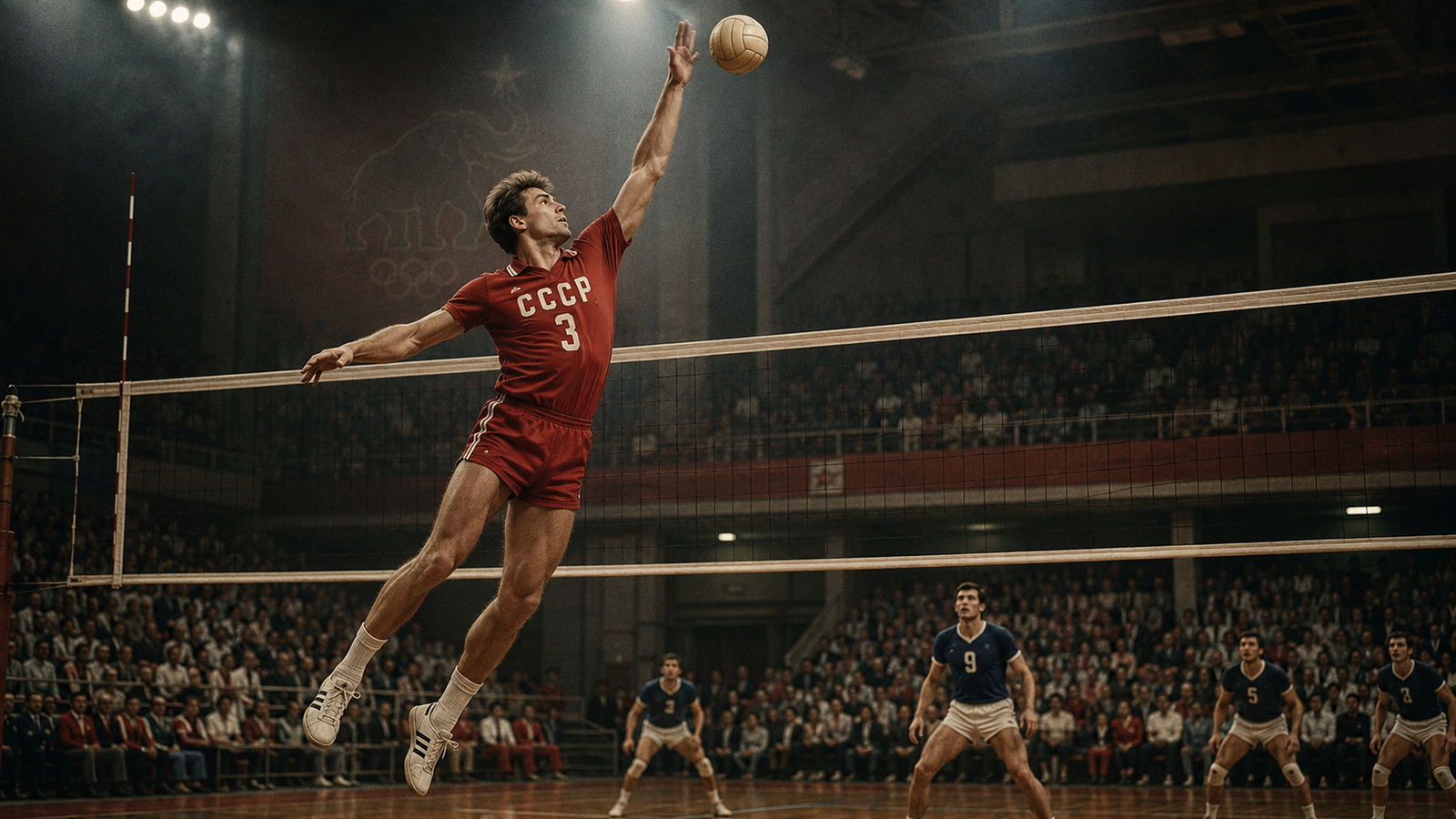
The Flying Elephant: Memoirs of an Olympic Champion Alexander Savin is a sports memoir that brings together the personal story of one of the Soviet Union’s most accomplished volleyball players with the history of an extraordinary era in international sport. Alexander Savin competed at two Olympic Games, winning silver with the Soviet Union at Montreal in 1976 before returning four years later to claim gold at the 1980 Moscow Olympics. Official Olympic records confirm both medals, while the International Volleyball Hall of Fame recognizes Savin as part of the generation that restored Soviet volleyball to the top of the Olympic podium.
For readers discovering Savin today, the attraction is not simply the Olympic gold medal. His career sits at the intersection of elite volleyball, Soviet sporting culture, team discipline, international competition, and the personal demands of life as a professional athlete. The memoir is therefore interesting even for readers who are not dedicated volleyball followers. It offers a chance to look beyond the medal ceremony and consider what years of preparation, disappointment, teamwork, and persistence actually mean when an athlete is competing at the highest possible level.
What Is The Flying Elephant: Memoirs of an Olympic Champion?
The Flying Elephant: Memoirs of an Olympic Champion is presented as Alexander Savin’s memoir of his life and career in volleyball. Current descriptions of the English edition characterize it as a substantial work, reported at around 514 pages and accompanied by more than 240 photographs and archival images. Because edition specifications can vary, readers should treat those details as information associated with the currently described English edition rather than timeless characteristics of every possible version.
The book is particularly interesting because Savin’s career unfolded during a period when Soviet volleyball was one of the major forces in the international game. His story includes the disappointment of losing the 1976 Olympic final and the eventual triumph of winning gold in Moscow four years later. That progression gives the memoir a natural dramatic arc: an elite athlete reaches the Olympic stage, experiences defeat, continues competing at the highest level, and eventually gets another opportunity to win the title.
Quick Facts About the Book
| Detail | Information |
|---|---|
| Book title | The Flying Elephant: Memoirs of an Olympic Champion |
| Author | Alexander Savin |
| Main subject | Volleyball and an Olympic career |
| Olympic silver | Montreal 1976 |
| Olympic gold | Moscow 1980 |
| Sport | Indoor volleyball |
| Historical setting | Soviet-era international volleyball |
| English edition | Reported as a translated edition |
| Reported length | Approximately 514 pages |
| Reported photographic material | More than 240 images |
The Olympic medal information is independently documented by Olympedia and the International Volleyball Hall of Fame.
Who Is Alexander Savin?
Alexander Borisovich Savin was born on July 1, 1957, in Taganrog, Russia. He became a major figure in Soviet volleyball and represented the Soviet Union at the 1976 and 1980 Olympic Games. Olympedia records him at 200 centimeters tall and identifies CSKA Moscow among his sporting affiliations.
Savin’s Olympic record alone tells an unusually compelling story. At Montreal in 1976, the Soviet men’s volleyball team reached the gold-medal match but lost to Poland, leaving Savin with a silver medal. At Moscow in 1980, the Soviet team won the tournament, defeating Bulgaria 3–1 in the final. The International Volleyball Hall of Fame notes that Savin played all five matches in Montreal and all six matches in Moscow.
That makes Savin’s career more than a simple story of Olympic victory. His journey contains both sides of elite sport: the satisfaction of reaching the summit and the frustration of falling short when victory appears within reach.
Alexander Savin’s Olympic Journey
Montreal 1976: The Silver Medal
Savin’s first Olympic appearance came at the 1976 Montreal Games. The Soviet team entered the competition with a formidable reputation and progressed through the tournament before reaching the final against Poland. The final ended in a 3–2 victory for Poland, leaving the Soviet Union with silver. Savin played throughout the tournament, gaining experience on one of the biggest sporting stages in the world.
A silver medal is an extraordinary achievement by almost any standard, but Olympic competition has a peculiar way of making second place feel like unfinished business. For Savin and his teammates, the result became part of the motivation for the next Olympic cycle. The four years that followed were filled with international success, helping establish the Soviet team as a dominant force heading toward Moscow.
Moscow 1980: Olympic Gold
The 1980 Olympic Games in Moscow provided Savin with the opportunity to finish what had begun in Montreal. The Soviet men’s volleyball team won its matches in the pool stage and advanced through the knockout rounds before meeting Bulgaria in the gold-medal match. The Soviets won 3–1, securing Olympic gold in front of their home crowd.
Savin again played in every match of the tournament. His Olympic career therefore ended with a remarkable transformation: silver in his first Games followed by gold in his second. Olympedia records one Olympic gold and one Olympic silver medal for him, while the European Volleyball Confederation describes him as one of the outstanding middle blockers in volleyball history.
The Volleyball Legacy Behind the Memoir
Savin’s Olympic achievements were part of a much larger international career. The European Volleyball Confederation describes him as a six-time European champion and notes his five Champions Cup victories. The International Volleyball Hall of Fame also highlights the Soviet team’s major international successes during the period in which Savin was one of its leading players.
This context matters when reading a memoir about Savin. His story does not take place in isolation. He competed during the Soviet Union’s highly organized sporting era, when international volleyball carried considerable prestige. Matches against Poland, Bulgaria, Cuba, Italy, Romania, and other major volleyball nations were not merely sporting events; they were part of a much wider international sporting landscape.
Major Milestones in Savin’s Olympic Story
| Year | Competition | Result |
| 1976 | Montreal Olympics | Silver medal |
| 1977 | European Championship | Gold |
| 1977 | FIVB World Cup | Gold |
| 1978 | FIVB World Championship | Gold |
| 1979 | European Championship | Gold |
| 1980 | Moscow Olympics | Gold |
| 1981 | FIVB World Cup | Gold |
| 1982 | FIVB World Championship | Gold |
The Olympic and broader international achievements are documented in historical volleyball records and Savin’s Hall of Fame profile.
Why The Flying Elephant Is More Than an Olympic Story
A medal list can tell us what an athlete achieved. A memoir can potentially show us what those achievements felt like from the inside. That distinction is one of the strongest reasons to be interested in The Flying Elephant. Instead of viewing Savin only as the player who won Olympic gold in Moscow, readers can approach the book as a window into the person behind the sporting record.
The historical setting adds another layer. Savin’s career developed during the Cold War period, when international sporting competitions often carried significance far beyond the court. Soviet athletes were competing not only against individual opponents but within a highly visible national sporting system. That background makes personal experiences of training, competition, pressure, teamwork, and success especially valuable to readers interested in sports history.
The Importance of the 1976 Defeat
One of the most interesting ways to understand Savin’s Olympic journey is to look at the contrast between Montreal and Moscow. In 1976, the Soviet team was heavily favored but lost the final to Poland. Four years later, the same broad sporting generation returned to the Olympic stage and won the championship.
That contrast illustrates something that is easy to overlook when looking only at winners. Elite careers are rarely straight lines. An athlete may spend years preparing for a single tournament, perform extremely well, and still walk away without the result they wanted. The ability to absorb that disappointment without allowing it to define the rest of a career is one of the most valuable themes associated with Savin’s Olympic story.
The Soviet Volleyball Era
Savin’s career also provides a useful entry point into the history of Soviet volleyball. During the late 1970s and early 1980s, the Soviet men’s team collected major international titles, including Olympic, World Championship, World Cup, and European Championship victories. The team environment was built around highly developed technical preparation, tactical discipline, and cooperation between players.
For modern readers, this historical background can make the memoir more rewarding. Volleyball has changed considerably over the decades, from tactics and training methods to the way the sport is presented globally. Reading about an athlete from that era offers an opportunity to understand not only one player’s career but also how the culture of high-level volleyball has evolved.
What Readers Can Learn From Alexander Savin’s Story
Persistence After Disappointment
Savin’s Olympic career offers an unusually clear example of persistence. He reached the Olympic final in 1976 and lost, then returned four years later and won the title. The important lesson is not simply that he eventually became a champion. It is that the earlier defeat did not become the final definition of his career.
For athletes, coaches, and even readers outside sport, that distinction matters. Failure at one important moment does not necessarily predict the outcome of the next opportunity. Progress often happens quietly between major events, when there is no audience and no medal waiting at the end of the day.
The Power of Teamwork
Volleyball is fundamentally a team sport. Even exceptional individual players cannot win a match alone. Savin’s Olympic record is therefore also the story of teammates, coaches, systems, and shared responsibility.
That makes the memoir potentially useful beyond volleyball. The same principle appears in business, education, leadership, and other competitive environments: individual talent matters, but coordinated performance often determines whether a group succeeds.
Long-Term Discipline
Savin’s career represents years of training rather than a single moment of Olympic success. His international achievements before and after the 1980 Games demonstrate sustained excellence rather than a short-lived peak.
For younger athletes, this is perhaps one of the most practical lessons. Great performance usually looks spectacular when seen from the outside, but it is normally built through repetition. Technique, physical preparation, tactical awareness, recovery, and mental discipline accumulate over time.
What Makes This Memoir Interesting for Volleyball Fans?
Volleyball enthusiasts have an obvious reason to explore The Flying Elephant: Alexander Savin was not a peripheral figure in the sport. The International Volleyball Hall of Fame inducted him in 2010, and the European Volleyball Confederation identifies him among the game’s outstanding middle blockers.
The book also belongs to a less commonly documented part of volleyball history. Much of modern sports literature naturally focuses on contemporary stars, major professional leagues, and recent Olympic competitions. Savin’s story reaches back to a very different sporting environment, giving readers an opportunity to explore an earlier generation of international volleyball through the perspective of one of its participants.
What Makes It Interesting for Non-Volleyball Readers?
You do not need to understand every volleyball rotation to appreciate the basic human story behind an Olympic memoir. Competition, disappointment, ambition, pressure, teamwork, and the passage from young athlete to experienced professional are universal themes.
The historical dimension may be equally appealing. Readers interested in the Soviet Union, Cold War-era sport, Olympic history, or biographies of remarkable people can approach the book as a cultural and personal story rather than simply a volleyball manual.
The Photographic Dimension
Current descriptions of the English edition report that the book contains more than 240 photographs and archival images. If that specification applies to the edition being considered, the photographs add an important visual dimension to the narrative, particularly because Savin’s career spans a period that is now several decades removed from modern professional sport.
Photographs can change how a historical memoir is experienced. A tournament result tells you who won, while an old team photograph can show the people, uniforms, venues, and atmosphere surrounding that era. For readers interested in sports history, that visual record can be nearly as valuable as the written narrative.
Is The Flying Elephant Worth Reading?
For readers interested in Olympic history, volleyball, Soviet sport, or athlete biographies, The Flying Elephant is a particularly relevant title to investigate. Savin’s career already provides a strong foundation for the story: Olympic silver in 1976, Olympic gold in 1980, and a broader international record that placed him among the leading players of his generation.
The strongest reason to read it, though, is not simply the list of achievements. The more interesting question is what happened behind those achievements. How did an elite player respond to disappointment? What did team life look like? How did a generation of Soviet volleyball players prepare for international competition? Those questions make a memoir more valuable than a conventional record book.
FAQ About The Flying Elephant: Memoirs of an Olympic Champion Alexander Savin
Who is Alexander Savin?
Alexander Borisovich Savin is a former Soviet volleyball player who represented the Soviet Union at the 1976 Montreal and 1980 Moscow Olympic Games. He won silver in Montreal and gold in Moscow. He was inducted into the International Volleyball Hall of Fame in 2010.
What is The Flying Elephant: Memoirs of an Olympic Champion about?
The memoir focuses on Alexander Savin’s life and career as an elite volleyball player. It is particularly relevant to readers interested in his Olympic experiences, Soviet volleyball, international competition, athletic discipline, and the personal story behind a championship career.
What Olympic medals did Alexander Savin win?
Savin won two Olympic medals. He earned silver with the Soviet men’s volleyball team at the 1976 Montreal Olympics and four years later won gold at the 1980 Moscow Olympics. Olympedia records one silver and one gold medal for his Olympic career.
Did Alexander Savin play in the 1980 Moscow Olympics?
Yes. Savin played in all six matches of the Soviet men’s volleyball tournament at the 1980 Moscow Games. The Soviet Union ultimately defeated Bulgaria 3–1 in the final to win the gold medal.
Why is Alexander Savin important in volleyball history?
Savin is remembered as one of the leading Soviet volleyball players of his generation. The European Volleyball Confederation describes him as one of the best middle blockers in volleyball history and notes his European and Champions Cup success. He was also inducted into the International Volleyball Hall of Fame.
Is The Flying Elephant only for volleyball fans?
No. While volleyball is central to the memoir, the broader themes of Olympic competition, resilience, teamwork, ambition, disappointment, and personal development can appeal to readers who enjoy sports biographies and historical memoirs.
How long is the English edition?
Current descriptions of the English Kindle edition report approximately 514 pages. Because digital editions can have different specifications, readers should verify the current edition information before purchasing.
Does the book contain photographs?
Current descriptions report more than 240 photographs and archival images. The exact contents can depend on the edition, so readers should check the specific edition details when purchasing.
What happened to Savin after winning Olympic gold?
Savin’s career extended beyond the 1980 Olympic title, with major international achievements continuing into the early 1980s. His wider career included European, World Cup, World Championship, and Champions Cup success, making the Olympic gold one important part of a much larger volleyball legacy.
Why is the 1976 Olympic silver medal important to his story?
The 1976 defeat gives his career an important sense of progression. Rather than winning Olympic gold immediately, Savin experienced the disappointment of losing the final before returning to the Games in 1980 and becoming an Olympic champion. That contrast makes his story particularly compelling.
Conclusion: Why Alexander Savin’s Story Still Matters
The Flying Elephant: Memoirs of an Olympic Champion Alexander Savin is compelling because Alexander Savin’s Olympic story was never simply about one gold medal. His career includes a painful defeat in Montreal, a successful return in Moscow, years of international victories, and a place in the history of Soviet and world volleyball. Official Olympic records and volleyball institutions confirm the remarkable scale of those achievements.
For volleyball fans, the memoir offers a connection to an important generation of the sport. For general readers, it offers something broader: a story about what happens when talent meets discipline, when disappointment becomes part of the journey, and when individual ambition has to operate inside a team. If you enjoy Olympic biographies, historic sports stories, or memoirs about people who competed at the highest level, Alexander Savin’s story is well worth exploring.




Leave a Reply