
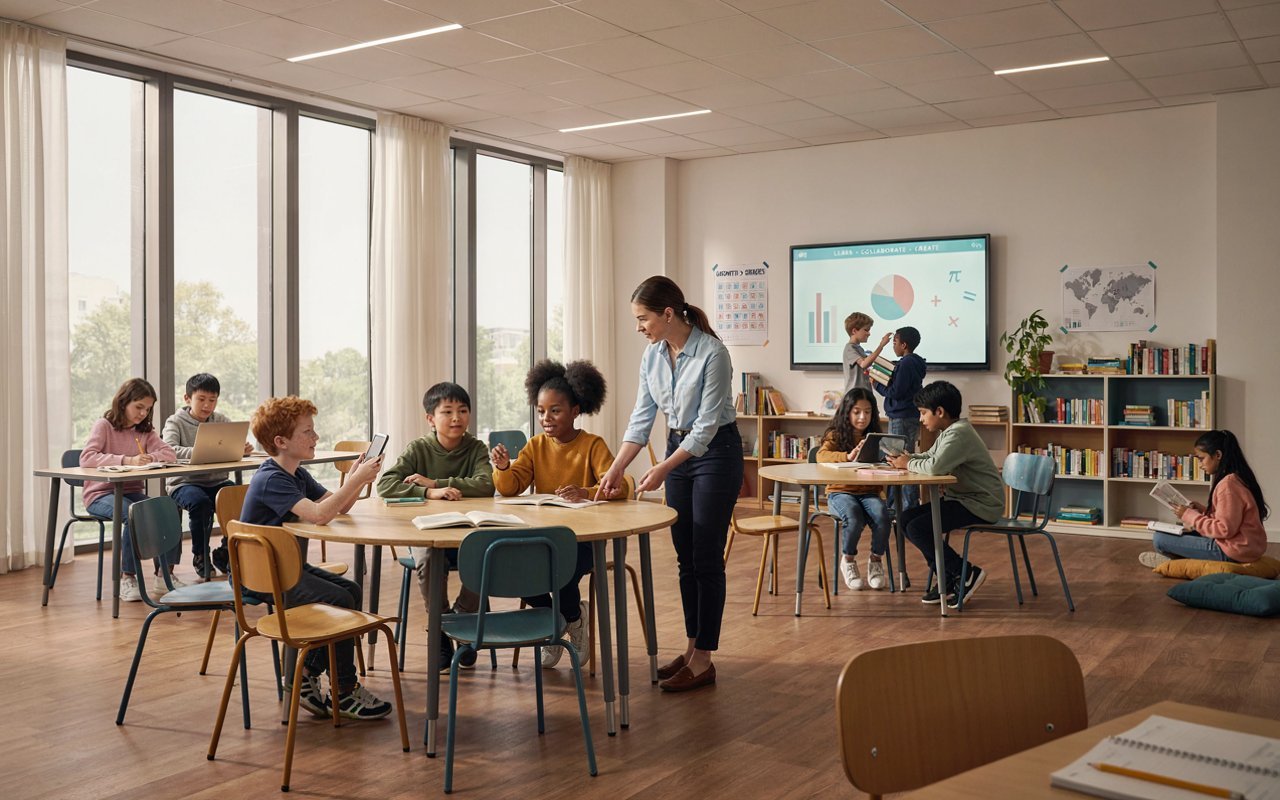
The phrase Classroom 15x has become surprisingly broad, and that is part of the reason people are curious about it. Depending on where you encounter the term, it can describe a modern approach to classroom design and teaching, or a browser-based collection of games commonly associated with students and school breaks. Because the name is used in more than one way, simply searching for Classroom 15x can leave you wondering what you are actually looking at.
In education, Classroom 15x is generally presented as a flexible, technology-supported learning environment that puts greater emphasis on student participation, personalized instruction, collaboration, and adaptable classroom spaces. Some online sources also use the name for gaming platforms offering browser-based titles. These are related by name rather than being one universally standardized educational system. Understanding that distinction makes the rest of the topic much easier to follow.
What Is Classroom 15x?
Classroom 15x is most often described as a modern classroom concept built around flexible learning, smaller groups, technology, and active participation. One interpretation associates “15” with a group of around 15 students, while the “x” represents the idea of expanding learning possibilities through better systems and resources. However, there is no universally recognized educational standard that officially defines the term in one fixed way.
The concept moves away from a classroom where every student simply faces the teacher and completes the same activity at the same pace. Instead, students may rotate between individual work, collaborative projects, teacher-led instruction, practical activities, and digital resources. The room itself can change depending on the lesson. That flexibility is one of the most interesting parts of the Classroom 15x idea.
Why the Meaning of Classroom 15x Can Be Confusing
A major source of confusion is that Classroom 15x is also used online to describe browser-based games intended for school-friendly entertainment or short breaks. Some websites present it primarily as a gaming destination, while others describe it as an educational framework. Recent online coverage reflects this split, with some sources explicitly noting that the same phrase can refer to both meanings.
For that reason, context matters. If a teacher is discussing flexible furniture, personalized learning, classroom technology, and student-centered instruction, they are probably referring to the educational concept. If a student is searching for browser games that work on a Chromebook, they may be looking for the gaming interpretation. The name is shared, but the purpose can be quite different.
How the Classroom 15x Learning Model Works
The educational version of Classroom 15x brings together several familiar ideas rather than relying on one magic piece of technology. Flexible seating, digital resources, collaborative activities, personalized tasks, short assessments, and teacher guidance can all work together to create a more responsive learning environment.
Imagine a mathematics lesson where fifteen students are not all doing exactly the same thing. A few students may work with the teacher on fractions, another group may complete a practical problem-solving activity, and others may use an educational application for additional practice. The teacher can move between groups instead of spending the entire lesson speaking from the front of the room. That simple change can make the classroom feel much more active.
Flexible Classroom Design
Physical space matters more than it sometimes gets credit for. Fixed rows of desks are useful for certain activities, especially tests or direct instruction, but they are not ideal for everything. A Classroom 15x-style environment can use movable desks, collaborative tables, quiet corners, presentation areas, and open spaces that can be rearranged according to the activity.
A science experiment, for example, might need groups around workstations, while independent reading may work better with quiet seating. A debate could require a circle or horseshoe arrangement. Instead of asking students to adapt to one permanent layout, the room adapts to the learning task.
Technology as a Learning Tool
Technology is another important part of the Classroom 15x concept. Tablets, interactive displays, learning platforms, digital quizzes, simulations, and other resources can give students different ways to interact with information. The goal, however, should not be to add screens simply because they look modern.
Good classroom technology solves a teaching problem. A digital simulation can demonstrate something difficult to recreate physically. An adaptive practice activity can give students additional work at an appropriate level. A shared digital workspace can make group collaboration easier. Used thoughtfully, technology becomes a tool rather than the lesson itself.
Personalized Learning in Classroom 15x
Students rarely learn at exactly the same speed. One student may understand a concept after one explanation, while another needs three examples and some guided practice. A Classroom 15x approach attempts to make room for those differences without making students feel as though they are being separated into “smart” and “weak” groups.
Teachers can use short checks for understanding, observation, student work, and digital progress information to decide what support is needed. One learner might receive additional practice, while another moves to a more challenging problem. Personalization does not necessarily mean creating a completely different lesson for every student; often, it means offering sensible choices within the same learning goal.
Benefits of Classroom 15x for Students
A well-designed Classroom 15x environment can encourage students to participate more actively in their own learning. Smaller working groups can make it easier for teachers to notice misunderstandings before they become bigger problems. Flexible spaces can also make collaboration feel more natural because students are not permanently separated by rows of desks.
There is another benefit that is easy to overlook: independence. When students know where resources are, understand classroom routines, and have some control over how they approach a task, they can gradually become less dependent on constant teacher instructions. That does not mean leaving students on their own. It means giving them enough structure to take meaningful responsibility.
Greater Student Engagement
Engagement is not simply about making lessons entertaining. A student can be entertained without learning very much. The stronger goal is meaningful participation, where students have to think, discuss, create, solve, explain, or apply something.
Classroom 15x activities can support this by combining direct teaching with projects, practical challenges, digital activities, discussions, and independent work. A history lesson might involve analyzing primary sources before a group discussion. A mathematics lesson might use a real-world budgeting challenge. These activities give students a reason to use what they have learned instead of simply memorizing it.
Better Teacher-Student Interaction
A smaller or more flexible learning environment can give teachers more opportunities to speak with individual students. Instead of waiting until the end of a unit to discover that someone has misunderstood the basics, the teacher can notice problems during practice.
This creates a more responsive teaching cycle. The teacher explains, observes, checks understanding, adjusts the lesson, and provides another opportunity to practice. That process is useful whether a classroom has sophisticated technology or nothing more than movable desks and good teaching.
Development of Future-Ready Skills
Modern education is expected to prepare students for more than examinations. Communication, collaboration, problem-solving, digital literacy, creativity, and independent thinking are increasingly important in further education and employment.
A Classroom 15x-style environment naturally creates opportunities to practice these abilities. Students may have to explain their reasoning to classmates, divide responsibilities during a project, research information digitally, present a solution, or revise their work after feedback. These experiences connect academic knowledge with practical skills.
Classroom 15x and Online Games
The second major meaning of Classroom 15x is associated with browser-based games. Several websites use the name for collections of games that students can access through a web browser, often promoting them for short breaks or casual entertainment. Some describe these games as suitable for Chromebooks or school environments.
This should not automatically be confused with an official school curriculum or educational framework. A browser game can be useful for relaxation, and some games may exercise skills such as logic, reaction, spatial reasoning, or problem-solving. But calling every game educational would be an exaggeration. Its value depends on the game, the student’s age, the amount of time spent playing, and how the activity fits into the wider school routine.
Are Classroom 15x Games Educational?
Some can support useful cognitive skills, particularly games involving logic, strategy, pattern recognition, planning, or problem-solving. A puzzle game may require students to recognize relationships and test different solutions. A strategy game can involve planning ahead and adapting when an approach fails.
Still, entertainment and education are not automatically the same thing. A game should not replace reading, writing, mathematical practice, scientific investigation, discussion, or teacher instruction. The most sensible approach is to treat games as an occasional supplementary activity rather than assuming that every game is an educational resource.
Classroom 15x vs. a Traditional Classroom
The biggest difference between a Classroom 15x-style environment and a traditional classroom is not one particular device or piece of furniture. It is the underlying philosophy of how learning is organized.
| Classroom 15x Approach | Traditional Classroom Approach |
|---|---|
| Flexible seating and spaces | Often fixed seating |
| Student-centered activities | Frequently teacher-led instruction |
| Personalized practice | Often common tasks for everyone |
| Digital tools used purposefully | Technology may play a smaller role |
| Collaboration and projects | More individual seatwork |
| Frequent feedback | Assessment may occur mainly at set points |
| Teacher acts as instructor and guide | Teacher primarily directs the lesson |
| Multiple learning activities | Often one activity for the whole class |
This does not mean traditional classrooms are automatically ineffective. Excellent teaching can happen in a conventional room, just as poor teaching can happen in a highly technological classroom. The physical environment supports learning, but teacher quality, curriculum, relationships, classroom management, and student needs remain central.
How to Create a Classroom 15x Environment
Schools do not need to rebuild an entire building to adopt useful elements of the Classroom 15x approach. A teacher can begin with small changes that make the existing classroom more flexible. Rearranging desks into temporary groups, creating a quiet working area, introducing short formative checks, or giving students controlled choices can make a noticeable difference.
Technology can also be introduced gradually. A school might begin with one shared display or a small number of devices before investing in a larger digital infrastructure. The strongest implementation is usually the one that solves real classroom problems rather than purchasing technology simply because it is fashionable.
Example of a Classroom 15x Lesson
Consider a 45-minute English lesson about persuasive writing. The first ten minutes could involve a short teacher explanation and an example paragraph. Students could then work in small groups to identify persuasive techniques in a sample text.
During the next part of the lesson, students could draft their own paragraph while the teacher works with a smaller group that needs additional support. The final few minutes could involve peer feedback and a short reflection. The same learning objective remains in place, but students experience several different ways of working rather than listening passively for the entire lesson.
A Simple Classroom 15x Activity Example
| Subject | Activity | Student Role | Teacher Role |
| Mathematics | Real-world budgeting task | Solve and explain | Coach and question |
| Science | Group experiment | Investigate and record | Guide and assess |
| English | Persuasive writing workshop | Draft and review | Give targeted feedback |
| History | Source investigation | Compare evidence | Challenge assumptions |
| Computer Science | Problem-solving challenge | Test solutions | Support debugging |
The important point is that the activity should have a clear learning purpose. Moving students into groups does not automatically make a lesson better. The arrangement should help students do something that would be harder to accomplish individually.
Challenges of the Classroom 15x Model
No classroom model is perfect. Flexible learning environments can require additional planning, teacher development, suitable furniture, reliable technology, and thoughtful classroom management. A school with limited resources may not be able to introduce every feature at once.
Technology can create problems of its own. Devices need maintenance, internet connections can fail, and students can become distracted if digital activities are poorly designed. Teachers also need time to learn new systems. These realities are important because an honest discussion of Classroom 15x should include limitations as well as attractive possibilities.
Cost and Resources
Flexible furniture, student devices, interactive displays, software subscriptions, and improved connectivity can become expensive. Schools should therefore consider what actually improves learning before spending money.
A low-cost classroom can still adopt many of the principles. Teachers can rearrange existing desks, establish collaborative routines, use printed resources, introduce peer feedback, and create differentiated activities without purchasing expensive equipment. The philosophy is more important than the price tag.
Teacher Training
A student-centered classroom requires teachers to manage several activities without losing sight of the learning objective. That can be more demanding than delivering one lecture to the entire class.
Professional development should therefore focus on practical classroom skills, including differentiation, formative assessment, collaborative learning, digital citizenship, classroom routines, and effective use of technology. Teachers should have opportunities to experiment, reflect, and improve rather than being expected to master everything immediately.
Who Can Benefit From Classroom 15x?
The Classroom 15x approach can be useful for primary schools, secondary schools, tutoring environments, vocational education, and other learning settings where students have different needs. It can also be adapted for different subjects because the underlying principles are not tied to one curriculum.
For teachers, the appeal is greater visibility into student progress and more opportunities for targeted support. For students, it can provide greater variety, collaboration, independence, and access to different learning resources. For school leaders, it offers a framework for thinking about how space, teaching, and technology can work together rather than being treated as separate issues.
Classroom 15x Biography Table
Because Classroom 15x is a term used for different concepts rather than a single universally recognized organization or individual, a conventional founder biography would be misleading. The table below provides useful context instead.
| Detail | Information |
| Subject | Classroom 15x |
| Category | Education, classroom innovation, and online gaming |
| Main educational idea | Flexible, student-centered learning |
| Common themes | Small groups, adaptable spaces, technology, personalization |
| Other online meaning | Browser-based games and school-break entertainment |
| Intended users | Students, teachers, parents, and education-focused readers |
| Core educational goal | More responsive and engaging learning experiences |
| Status | The term does not have one universally standardized definition |
Frequently Asked Questions About Classroom 15x
What is Classroom 15x?
Classroom 15x is a term used online to describe more than one concept. In education, it generally refers to a flexible, technology-supported and student-centered learning environment involving ideas such as smaller groups, adaptable classroom layouts, personalized instruction, and active learning. The term is also used by some websites for browser-based games intended for students.
What does the 15x mean in Classroom 15x?
There is no single universally accepted definition of “15x.” Some descriptions connect the number 15 with a target group size of approximately fifteen students, while others use it to suggest multiplying learning effectiveness or possibilities. Because different websites define the term differently, it is better to consider the surrounding context instead of assuming one official meaning.
Is Classroom 15x an official educational program?
Not in the sense of a universally recognized curriculum or standardized educational program. Online sources use Classroom 15x to describe different ideas, including modern classroom design models and gaming platforms. Educators should therefore examine the specific resource or framework being discussed before treating it as an established educational standard.
Is Classroom 15x only for schools with expensive technology?
No. Many principles associated with the Classroom 15x model can be introduced without major technology investments. Flexible seating, collaborative activities, differentiated assignments, peer feedback, short assessments, and student choice can all be implemented with ordinary classroom resources.
Can Classroom 15x improve student engagement?
It can support engagement when its features are connected to meaningful learning. Students may participate more actively when they can collaborate, solve problems, work at an appropriate level, and interact with lessons in different ways. However, no classroom layout guarantees better engagement. The quality of instruction and the relevance of activities remain extremely important.
Are Classroom 15x games safe for students?
Safety depends on the specific website, game, advertising, privacy practices, and school network. Parents and teachers should not assume that a site is safe simply because its name includes “Classroom” or “15x.” Schools should review online resources, follow their acceptable-use policies, and supervise student access appropriately.
Can teachers use Classroom 15x ideas in an ordinary classroom?
Yes. Teachers can borrow the underlying ideas without completely redesigning their classrooms. A teacher might begin by creating small-group stations, introducing flexible seating arrangements, using short formative assessments, and providing different levels of practice. Small changes can be more practical than attempting a complete transformation overnight.
What is the difference between Classroom 15x and Classroom15x games?
The educational interpretation focuses on teaching, classroom design, personalization, technology, and student-centered learning. The gaming interpretation refers to websites or platforms offering browser-based games. They share a similar name, but they should not automatically be treated as the same product, organization, or educational system.
Is Classroom 15x suitable for every age group?
The principles can be adapted across age groups, but implementation should reflect students’ developmental needs. Younger learners may benefit from highly structured collaborative activities and hands-on learning, while older students may have more independence with research, digital projects, and self-directed tasks. The right approach depends on the curriculum and learners.
Conclusion: Is Classroom 15x Worth Exploring?
Classroom 15x is best understood as a broad and somewhat flexible term rather than a single, universally defined system. In its educational sense, it represents an appealing shift toward flexible spaces, purposeful technology, personalized learning, collaboration, and stronger student participation. In its other common online use, it can refer to browser-based games designed for casual or school-break entertainment.
The most valuable lesson is not that every classroom needs fifteen students, expensive devices, or a futuristic design. It is that learning improves when the environment is deliberately designed around how students actually learn. A movable desk, a well-planned group task, a useful digital resource, or a timely conversation with one student can sometimes matter more than an expensive piece of equipment.
If you are a teacher, start small. Try one flexible seating arrangement, one collaborative activity, or one personalized learning routine and see how your students respond. If you are a parent or student researching Classroom 15x, look beyond the name and understand exactly which platform or educational concept you are considering. The strongest classroom is not necessarily the most high-tech one; it is the one where students feel supported, challenged, involved, and ready to learn.



Leave a Reply