
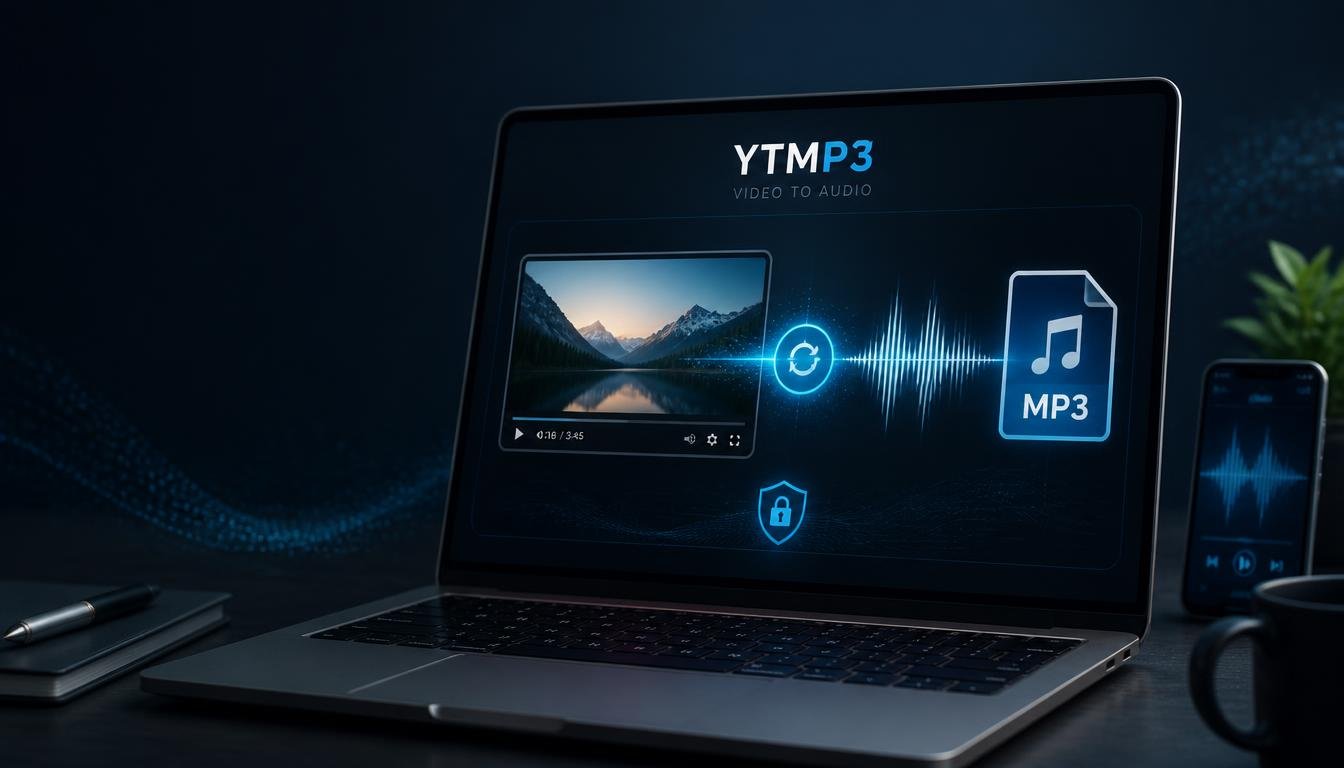
If you have searched for YTMP3, you were probably looking for a quick way to turn online video content into an audio file. The term is commonly associated with web-based YouTube-to-MP3 converters that take a video URL and process it into an audio format such as MP3. The basic idea sounds simple, but there is more to understand than simply copying a link and clicking a button.
YTMP3 is also a confusing search term because it does not necessarily point to one permanent, universally recognized service. Different websites have used the name or similar branding over time, and their features, domains, advertisements, and safety practices can vary considerably. That makes it important to understand what the term means, what these services actually do, and what you should consider before using one.
What Is YTMP3?
YTMP3 is commonly used to describe an online service or category of services designed to extract audio from online videos and provide it as an MP3 file. In a typical converter, a user enters a video URL, selects an output format, and waits while the service processes the media. Some versions also offer video formats such as MP4, although the main association with YTMP3 is audio conversion.
The technology behind these services is relatively straightforward from the user’s perspective. The website receives a media URL, processes the available content on its servers or through another conversion system, and prepares an output file. The exact technical process can differ between services, which is one reason why speed, audio quality, availability, and reliability are not identical across every YTMP3-branded website.
Why Do People Search for YTMP3?
The appeal is mostly convenience. Someone may want audio from a video they created themselves, a public-domain recording, a Creative Commons work with appropriate permissions, or another piece of content they are legally entitled to download and convert. In those situations, an online converter can appear easier than installing dedicated desktop software.
There is another reason the term remains popular: the workflow is easy to understand. Users generally associate it with a simple sequence of finding content, providing its URL, selecting an audio format, and receiving a file. That simplicity is attractive, particularly for people who do not want to learn complicated media-editing software.
How Does YTMP3 Work?
A typical YouTube-to-MP3 service follows a relatively simple process behind the scenes. The user provides a video address, and the service attempts to identify and process the corresponding media. The audio stream is then prepared in a format such as MP3, after which the service may provide the resulting file to the user.
The visible interface can make the process look almost instantaneous, but several technical steps may happen in the background. These can include identifying the source media, retrieving an available stream, decoding or processing the audio, converting it into the requested format, and preparing the resulting file. Processing time can therefore depend on the source, server load, video length, and the particular service being used.
Does YTMP3 Require Software Installation?
Many websites using the YTMP3 name present themselves as browser-based services, meaning users do not need to install a dedicated converter application. This can make them convenient on computers, phones, and tablets. However, browser-based does not automatically mean trustworthy or secure.
A website may display aggressive advertisements, misleading download buttons, redirects, notification requests, or other unwanted elements. For that reason, users should treat unfamiliar converter websites cautiously rather than assuming that a simple interface guarantees safety.
What Audio Quality Can You Expect From YTMP3?
Audio quality depends heavily on the original source and the conversion process. Converting a low-quality source into a higher-bitrate MP3 does not magically restore information that was never present in the original recording. If the source audio is already compressed, another lossy conversion can reduce quality further.
This is why claims about extremely high-quality output should be treated carefully. A converter may offer a high bitrate as an output setting, but the final file cannot necessarily contain more genuine audio detail than the original source. For personal audio that you own, keeping the original high-quality file and creating an MP3 copy from that master is generally a better approach.
MP3 vs. Original Audio
MP3 is a compressed audio format designed to reduce file size while maintaining reasonable listening quality. It remains useful because it is widely supported and relatively small. However, it is not the same thing as an original lossless recording.
For content you own, consider keeping an original WAV, FLAC, or other lossless master file separately. An MP3 can then be created as a convenient listening copy without replacing the original source.
Is YTMP3 Safe?
There is no universal answer because YTMP3 is not necessarily one single website. Different domains using similar names can have completely different owners, advertising systems, security practices, and privacy policies. Some current YTMP3-branded websites make strong claims about being free, fast, or secure, but those claims should not automatically be treated as independently verified facts.
The biggest practical concern is often not the conversion itself but the surrounding website environment. A suspicious converter page may use deceptive buttons, pop-ups, redirects, fake browser warnings, or requests to enable notifications. Clicking the wrong element can take you somewhere completely unrelated to the conversion process.
Common Warning Signs
Be especially cautious if a converter suddenly asks you to install an unknown application, browser extension, or executable file. Unexpected security warnings, repeated redirects, fake update messages, and requests for unnecessary personal information are also reasons to leave the website.
A legitimate need to convert your own media normally does not require handing over passwords, banking information, or unrelated personal details. If a website asks for information that has nothing to do with processing the media, there is little reason to provide it.
Is YTMP3 Legal?
The legality of using a YouTube-to-MP3 converter depends on several factors, including what content is being converted, who owns it, what permission exists, and the laws applicable to the user. Converting your own content or material that you are legally permitted to download is fundamentally different from downloading copyrighted material without authorization.
YouTube’s Terms of Service state that users may access content as made available through the service, but also restrict downloading or reproducing content except where specifically permitted by the service, with permission from the relevant rights holders, or where applicable law permits it.
That distinction matters. The fact that a website technically allows a file to be processed does not automatically mean that the user has permission to copy or redistribute the underlying content. Copyright law can also differ between countries, so users should consider the rules applicable to their particular situation.
Can You Convert Your Own YouTube Videos?
If you created and own the underlying content, the situation can be much simpler, although you should still consider any third-party material included in the video. For example, a video containing music, footage, photographs, or other copyrighted material owned by someone else may involve rights that you do not control.
For your own recordings, maintaining the original project or master file is preferable whenever possible. That gives you greater control over quality and avoids relying on an online converter as your only copy.
YTMP3 and Copyright: What Should Users Know?
Copyright is one of the most important issues surrounding online media converters. A video being publicly accessible does not necessarily mean that anyone has unrestricted permission to copy, extract, redistribute, or commercially reuse it.
For example, imagine that someone uploads an original lecture to YouTube and explicitly gives viewers permission to download and reuse the audio. Converting that permitted material can be very different from extracting a commercially released song and distributing the resulting MP3 without authorization.
The safest approach is to ask a simple question before converting anything: Do I own this content, or do I have permission or another valid legal basis to make this copy? If the answer is no, using an unofficial converter may create copyright or terms-of-service problems.
What Are the Main Advantages of YTMP3-Style Services?
The biggest advantage is convenience. Browser-based converters can eliminate the need to learn specialized media software, and many are designed around a straightforward interface. For someone working with media they are authorized to convert, that simplicity can be useful.
Another advantage is compatibility. A browser-based workflow can potentially work across different operating systems without requiring a dedicated application. However, convenience should not be confused with reliability or safety, because those characteristics vary considerably between websites using similar branding.
| Feature | Potential Benefit | Important Consideration |
|---|---|---|
| Browser-based conversion | No dedicated software may be required | Website safety varies |
| MP3 output | Small, widely compatible audio files | Compression can reduce quality |
| Simple interface | Easy for beginners | Misleading buttons may appear |
| Fast processing | Convenient for short files | Speed depends on the service and source |
| Multiple devices | Can work on phones and computers | Mobile redirects can be problematic |
What Are the Disadvantages?
The biggest disadvantage is uncertainty. Because YTMP3 can refer to different websites, users cannot assume that one site’s policies, safety standards, or technical performance apply to another. A familiar-looking name does not establish ownership or reliability.
There can also be quality limitations. The output may be re-encoded, and the resulting MP3 may contain less audio information than the original source. In addition, some services may impose restrictions, display aggressive advertising, or stop working when the underlying platform changes.
Privacy is another consideration. Before using an unfamiliar service, think about what information the website receives and whether you are comfortable with its privacy practices. Uploading or submitting sensitive media to a third-party service is particularly worth avoiding unless there is a clear reason and appropriate trust.
What Is a Safer Way to Get Offline Audio?
If your goal is simply offline listening to content available through YouTube, official features are often the better starting point. YouTube provides permitted offline functionality through its own services in supported circumstances, avoiding the need to rely on an unrelated conversion website.
For creators, another sensible option is to maintain the original audio files separately. If you own a podcast, music recording, lecture, or video, you can export the audio directly from your original project using established media software. That approach gives you control over quality and avoids unnecessary third-party processing.
For music intended to be reused in videos or other projects, look specifically for material whose licensing allows the use you have in mind. Permission, licensing terms, and attribution requirements should be checked before publishing or distributing the resulting work.
How Can You Choose a Reliable Converter?
There is no simple label that makes an online converter automatically trustworthy. Instead, evaluate the website itself. Look for clear ownership information, understandable policies, sensible interface behavior, and the absence of suspicious download prompts.
Avoid websites that pressure you into installing unknown software or granting unnecessary browser permissions. A converter that requires several unrelated permissions before allowing a basic media operation deserves additional scrutiny.
It is also worth remembering that domain names can change. A website you used months ago may not necessarily be operated by the same people today. If a familiar YTMP3 page suddenly looks completely different or begins redirecting you elsewhere, do not assume that it is still the same service.
Common Mistakes People Make With YTMP3
One common mistake is assuming that every website carrying the YTMP3 name is the same service. In reality, the name has appeared across multiple domains and variations, making it difficult to treat the keyword as a single permanent brand. Current search results show several different services using similar YTMP3 branding.
Another mistake is focusing entirely on download speed while ignoring the source and the rights attached to it. A fast conversion does not make an unauthorized copy permissible, and a high bitrate does not automatically produce better sound.
A final mistake is trusting every button on a free converter page. Some websites use advertising designs that make advertisements look similar to actual controls. Taking a few seconds to identify the genuine interface can prevent unwanted downloads or redirects.
YTMP3 Alternatives for Different Needs
The best alternative depends on what you are actually trying to accomplish. If you want offline access to content that you are permitted to save, an official platform feature may be the simplest option. If you own the original media, dedicated audio or video software can give you greater control over quality and file formats.
For creators who need background music, licensed music libraries are generally more appropriate than extracting commercial recordings from videos. This approach can also make it easier to understand whether attribution is required and whether commercial use is permitted.
The important point is that the best tool is not necessarily the one that produces a file fastest. It is the one that solves your actual problem while respecting the rights attached to the content and keeping your device and information reasonably protected.
Frequently Asked Questions About YTMP3
What does YTMP3 mean?
YTMP3 is commonly used as a name or search term for services that convert online video content, particularly YouTube videos, into MP3 audio files. Because multiple websites have used similar branding, the term does not always identify one single permanent service.
Is YTMP3 free?
Many websites using the YTMP3 name advertise free conversion services. However, features and conditions can vary between domains, and “free” does not necessarily mean that a service is safe, private, or appropriate for every type of content.
Can YTMP3 convert a video into MP3?
YTMP3-style services are generally designed around converting video content into an audio format such as MP3. Whether a particular service currently supports a specific video or format depends on that website and the source content.
Is using YTMP3 safe?
Safety varies considerably between different websites using the YTMP3 name. Users should watch for aggressive redirects, suspicious downloads, fake warnings, notification requests, and other unusual behavior. Do not install unknown software simply because a converter page tells you that it is necessary.
Is downloading YouTube videos as MP3 legal?
It depends on the content, your permission to copy it, the applicable law, and the platform’s terms. YouTube’s terms restrict downloading and reproducing content except in circumstances permitted by the service, with appropriate permission, or where applicable law allows it.
Can I use YTMP3 for my own videos?
If you own the content and have the necessary rights to all material contained in it, converting your own media may be a reasonable use case. Keeping the original video or audio files is still preferable because it preserves the highest-quality source.
Does converting a video to a higher MP3 bitrate improve sound quality?
Not necessarily. A higher output bitrate cannot restore audio information that was already lost in the source. If the original audio is low quality, exporting it at a higher bitrate generally creates a larger file without recreating missing detail.
Why do some YTMP3 websites look different?
YTMP3 is used by multiple websites and domains, so there is no guarantee that every page using the name belongs to the same operator. Websites can also change their designs, domains, advertising systems, and available features over time.
Conclusion: Should You Use YTMP3?
YTMP3 is best understood as a commonly used name for online YouTube-to-MP3 conversion services rather than assuming that every YTMP3-branded website is one identical platform. These services can be convenient for legitimate media-conversion needs, particularly when you own the content or have clear permission to make a copy.
The bigger picture matters, though. Before using any converter, consider the copyright status of the material, the terms governing the platform, the security of the website, and the quality you actually need. YouTube’s own terms place meaningful restrictions on downloading and reproducing content, so convenience should never be treated as automatic permission.
If you need offline audio, start with the safest and most appropriate option for your situation. Use official offline features when available, keep original files for content you own, and choose properly licensed sources when you need music or other material for a project. That small amount of caution can save you from copyright problems, poor-quality files, and questionable websites.



Leave a Reply