
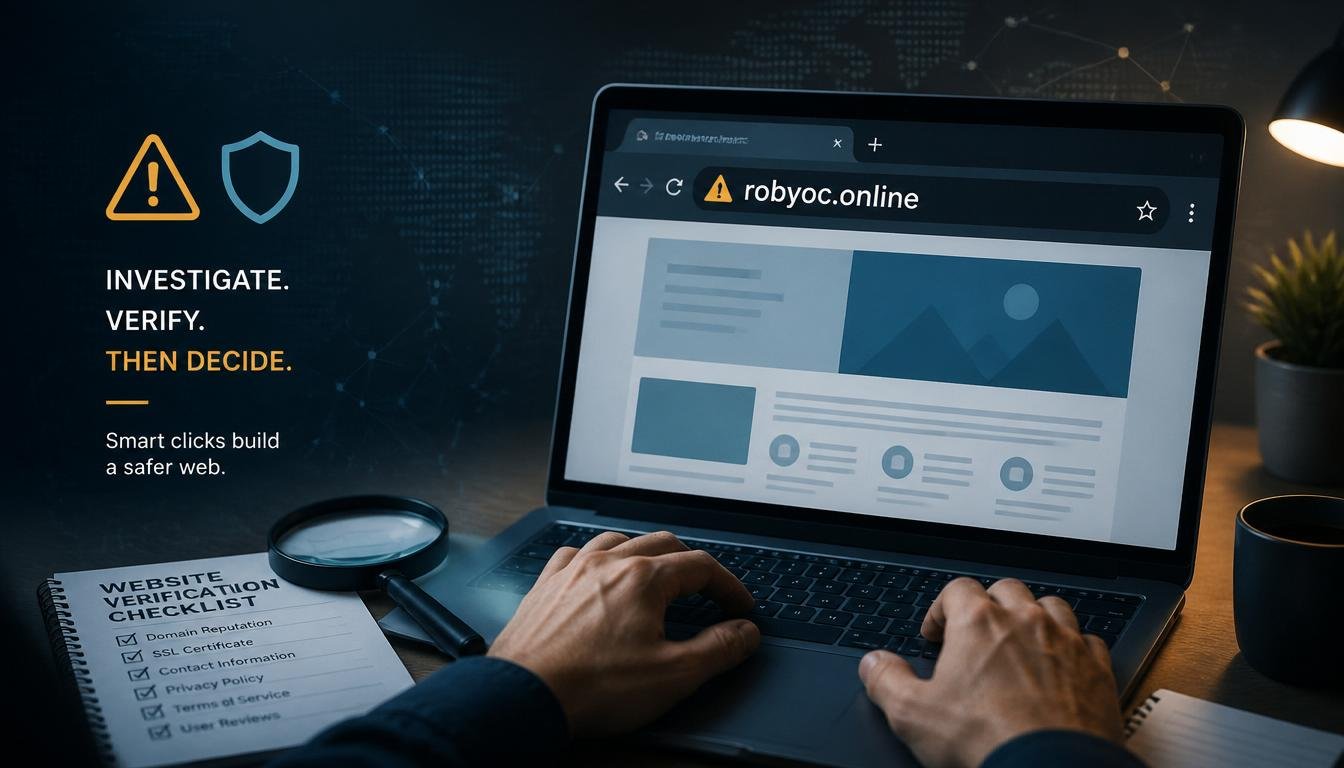
If you searched for robyoc.online, you probably want a straightforward answer: what is this website, and can you trust it? The honest answer is that it should be treated as an unverified, high-caution domain, not as an established service. Public information about its operator, purpose, reputation, and business identity is limited, while automated website-checking services have produced mixed results—from a medium-risk assessment to a very low trust warning. That does not, by itself, prove that every visit is malicious. It does mean that a sensible visitor should not log in, download software, send money, or provide personal information there.
This guide separates confirmed signals from assumptions. It explains how to assess the domain, why HTTPS is not proof of legitimacy, how phishing pages work, and what to do if you already interacted with the site. Because unfamiliar domains can change owners or content, this assessment is time-sensitive: consider it a practical safety guide for July 2026, rather than a permanent verdict.
What Is robyoc.online?
At the time of this review, there is no reliably documented public identity behind robyoc.online that would allow a reader to verify a company, product, publisher, or service with confidence. Search results describe it in inconsistent ways, and some pages appear to be generic reviews rather than official documentation. That distinction matters. A third-party article saying that a domain is “safe” is not the same as the operator publishing a verifiable company name, physical address, support channel, terms of service, and accountable privacy policy.
A domain can be technically real without representing a trustworthy organization. It may be newly launched, parked, repurposed, used for advertising, or configured to redirect visitors. It could also be a harmless personal project. The point is not to guess which explanation is true; it is to identify what can actually be verified. For now, the most defensible description is an unknown and insufficiently transparent website.
| Question | Practical assessment |
|---|---|
| Does the domain exist? | Yes, public reports identify the domain. Availability and content can change. |
| Is the operator clearly identified? | Not sufficiently verified in the public information reviewed. |
| Is it a recognized brand? | There is no strong, independently established reputation. |
| Does HTTPS prove it is safe? | No. HTTPS protects the connection, not the honesty of the site. |
| Should you enter a password or card number? | No, unless the operator and purpose are independently verified. |
| Is every visit automatically harmful? | Not necessarily, but uncertainty warrants caution. |
Is robyoc.online Safe?
The safest short answer is: do not treat robyoc.online as trusted. A cautious person may inspect a public page without submitting information, but should avoid all high-risk actions. In particular, do not reuse a password, approve a browser notification, install an extension, run a downloaded file, connect a cryptocurrency wallet, or enter payment details simply because the page looks polished.
This is a risk-management conclusion, not an accusation. There is a meaningful difference between “I found proof this site is criminal” and “I cannot verify enough about this site to recommend using it.” For an unknown domain, the second statement is enough to justify withholding sensitive data. A website asking for a login or payment has to earn trust; the visitor does not have to take a gamble.
A padlock icon only means that the browser established an encrypted connection to the domain. Criminal websites can obtain certificates too, and legitimate sites can still misuse data. The United States Federal Trade Commission explains how phishing attempts imitate trusted businesses and ask people to click links or disclose information; its consumer guidance is useful for evaluating suspicious messages and websites. The FTC phishing guidance is a good reference.
The same principle applies to security scanners. A clean result is not a guarantee, and a poor result deserves attention even if the page loads normally. Automated ratings are clues, not verdicts. When several independent warning signs point in the same direction—hidden ownership, low visibility, unexplained redirects, aggressive prompts, or suspicious downloads—the rational decision is to leave.
Why Website-Checking Services Disagree
Readers often see one service give a domain a score around the middle of its scale and another label it “very low trust.” That can look contradictory, but it is normal. These platforms use different datasets, weighting systems, scan dates, and definitions of risk. One may emphasize domain age and HTTPS; another may give more weight to server neighborhoods, abuse reports, traffic patterns, or ownership privacy.
A score is therefore best read as a screening signal. It is not a laboratory certification. A medium score does not mean “approved,” and a low score does not explain exactly what happened. It tells you to investigate further.
| Signal | What it can tell you | What it cannot tell you |
|---|---|---|
| HTTPS certificate | The connection is encrypted in transit | That the owner is honest or the page is malware-free |
| Private WHOIS details | The registrant uses privacy protection | That the owner is fraudulent |
| Low traffic | The site is not widely established | That it is definitely dangerous |
| Shared hosting warnings | Other questionable domains may use nearby infrastructure | That all sites on the server are related |
| Automated trust score | A pattern detected by one service | A definitive legal or security judgment |
| User reviews | Personal experiences and possible warnings | That every review is genuine or representative |
The better approach is to combine signals with the page’s behavior. If a site has little history but simply publishes a transparent, verifiable project page, risk may be limited. If it has little history and asks for credentials, money, or an executable download, the risk profile changes sharply.
Red Flags to Examine
1. Unclear ownership
A trustworthy commercial site normally tells you who operates it. Look for a legal business name, a working contact address, a support email on the same domain, and a privacy notice that identifies the data controller. Generic contact forms are not enough. If the site makes financial or health claims, the standard should be even higher.
Privacy-protected registration is common and not automatically suspicious. Many individuals and small businesses use it to reduce spam. It becomes concerning when privacy protection is combined with no company details, no history, no accountable support, and a request for sensitive information.
2. No clear purpose
Within seconds, a visitor should understand what a website offers and who it serves. Vague claims such as “unlock benefits,” “verify your account,” or “claim your reward” are deliberately broad. A site that cannot explain its service plainly should not be trusted with a login or payment.
3. Unexpected redirects and pop-ups
Redirect chains can send visitors through advertising networks, tracking systems, or other domains. A redirect does not automatically indicate malware, but it makes the final destination harder to evaluate. Close tabs that open unexpectedly. Never keep clicking “Allow,” “Continue,” or “Verify” merely to make an intrusive prompt disappear.
4. Requests for credentials
A page that resembles Roblox, Google, a bank, a social network, or an email provider may still be a copy. Check the address bar character by character. The safest habit is to open the official app or type the known address yourself instead of following a login link from an unfamiliar domain.
5. Downloads or browser extensions
A website cannot become trustworthy because it offers a “security tool,” “player,” “update,” or “special extension.” Executable files and browser extensions can access files, browsing data, sessions, or credentials depending on their permissions. The Cybersecurity and Infrastructure Security Agency offers practical advice on recognizing phishing and protecting accounts in its phishing guidance.
6. Pressure and artificial urgency
“Your account will be deleted today” and “only five minutes left” are classic pressure tactics. Urgency is designed to interrupt verification. Pause, close the page, and contact the supposed organization through an independently located official channel.
7. Unbelievable offers
Free currency, instant prizes, guaranteed earnings, and extreme discounts are not evidence of a good opportunity. They are common bait. The more valuable the promise, the more important it is to verify the source, the terms, and the organization behind it.
How to Inspect the Site Safely
Start with passive observation. Do not sign in or click through a prompt just to see what happens. Record the exact domain, including spelling and the ending after the final dot. Look for extra hyphens, substituted letters, strange subdomains, and a different domain after a redirect.
Next, inspect the site’s identity. Is there a real “About” page? Does it name an accountable organization? Does the privacy policy explain what is collected, why it is collected, how long it is retained, and how to request deletion? Do the terms identify a jurisdiction and a contact method? A template full of vague language is a weak trust signal.
Then examine the requested action. Reading public information is low risk compared with creating an account. Creating an account is lower risk than giving a payment card, and a payment is lower risk than uploading identity documents. Treat every increase in requested access as a new decision rather than assuming the first harmless page proves the whole site is safe.
For technical context, the Internet Corporation for Assigned Names and Numbers explains domain registration data and WHOIS services. Registration information can help establish age, registrar, and status, but it may be privacy-protected or incomplete. Use it as one piece of evidence, not as proof of legitimacy.
What Not to Do on robyoc.online
Do not enter a password that you use anywhere else. Do not provide your full name, phone number, national identification number, address, date of birth, recovery codes, or one-time authentication code. Never send cryptocurrency or gift-card codes to an unknown operator, because those payments are difficult to reverse. Do not install a file, bookmarklet, extension, or “verification tool” supplied by the page.
Do not assume a browser warning is an inconvenience to bypass. Warnings can be triggered by phishing, malware, deceptive content, or a compromised site. If your browser, antivirus software, DNS filter, or internet provider blocks the domain, respect the warning unless you have a clear, independently verified reason to investigate in a controlled environment.
What to Do If You Already Visited
If you only opened the page and did nothing else, the practical response is usually simple: close the tab, do not revisit it, and keep your browser and operating system updated. Clear site permissions if the page asked for notifications, camera, microphone, clipboard, or location access. Review your browser’s downloads list and remove anything you did not intentionally install.
If you entered a password, change it immediately from the official service—not through the suspicious page. Change it anywhere else that reused the same password. Sign out of other sessions, check recovery email and phone settings, enable multifactor authentication, and review recent account activity. For a Roblox account, use official Roblox support and account-security resources rather than a third-party “recovery” page; the official Roblox safety information is the appropriate starting point.
If you supplied card information, contact the card issuer using the number on the card or its official app. Ask whether the card should be frozen or replaced and monitor transactions. If you transferred money, contact the bank or payment provider quickly; speed can affect recovery options. Keep screenshots, URLs, emails, transaction records, and timestamps. They may help a provider investigate.
If you downloaded and opened a file, disconnect the device from sensitive accounts while you assess it. Run a reputable, updated security scan, remove unfamiliar programs and extensions, and consider professional help if the device behaves unusually. Signs such as repeated redirects, new toolbars, disabled security software, unexpected login alerts, or unexplained account activity deserve prompt attention.
Privacy, Payments, and Downloads
Privacy risk is not limited to losing money. A seemingly harmless form can build a profile from your email, phone number, device details, and browsing behavior. That information may be sold, reused in later scams, or combined with data from breaches. A privacy policy is meaningful only when it is specific, consistent with the site’s behavior, and attached to an identifiable operator.
Payment risk has two layers. First, the transaction may be fraudulent or the promised service may never arrive. Second, the card or wallet details may be retained or misused. Use established payment providers and avoid direct transfers to unknown recipients. Never disclose a one-time code to someone claiming to “verify” a payment.
Downloads carry a different kind of risk. A file can be malicious even when its name looks ordinary, and an extension can abuse permissions without displaying obvious symptoms. Official app stores reduce—not eliminate—risk. Verify the developer, reviews, update history, permissions, and official publisher website before installing anything.
How to Compare It With a Legitimate Website
A legitimate service usually has continuity. Its name appears in independent coverage, professional profiles, customer discussions, public records where relevant, and long-standing social accounts. Its contact information remains consistent. Its published policies describe a real operation rather than simply repeating promises.
Legitimacy also survives scrutiny. You can find the organization without relying on the suspicious website itself. You can call a verified number, use a known app, or navigate from an official parent company. The site does not need to be famous, but it should be explainable.
| Trust question | Stronger signal | Weaker signal |
|---|---|---|
| Who runs it? | Verifiable organization and accountable contact | Anonymous operator and generic form |
| Why does it exist? | Specific service with clear terms | Vague rewards or urgent verification |
| How long has it operated? | Consistent history across independent sources | New or constantly changing footprint |
| How does it handle data? | Specific privacy policy and minimal collection | Broad permissions and unclear retention |
| How do users pay? | Reversible, established payment methods | Crypto, gift cards, or direct transfers |
| How is support provided? | Official channels found independently | Messaging contact only through the site |
Common Mistakes Visitors Make
The first mistake is confusing design with credibility. A copied logo, polished typography, and a professional color scheme are easy to reproduce. Trust comes from verifiable identity, consistent history, transparent practices, and behavior that matches the stated purpose.
The second mistake is relying on one green scanner result. Security tools have blind spots and may not have seen a newly deployed page. A domain can be clean today and compromised tomorrow. Check multiple signals and pay attention to what the site asks you to do.
The third mistake is searching for the brand and clicking the first result without checking the address. Paid advertisements, hacked pages, and lookalike domains can appear above the official source. For an account or payment, type the known address or use the official app.
The fourth mistake is returning to a suspicious site to “test” it with a fake password. Even a fake credential can reveal your email format, create a tracking profile, or expose you to more prompts. The safer test is no test: do not submit information.
Expert Checklist for Unfamiliar Domains
Use this short decision rule before interacting with any unknown site. If the page asks for secrets, money, software installation, or unusual permissions, stop first. Independently verify the organization through a known channel. Confirm the domain exactly and look for a coherent history. If two or more important questions remain unanswered, treat the site as untrusted.
For publishers and educators discussing robyoc.online, be precise with language. Say that the domain is “unverified,” “high caution,” or “associated with warning signals” unless you have direct evidence of a specific crime or technical compromise. Avoid claiming that a scanner score proves malware. Good reporting distinguishes observation, source assessment, and conclusion.
Frequently Asked Questions
Is robyoc.online a legitimate website?
There is not enough independently verifiable information to recommend treating robyoc.online as legitimate. The domain may exist and load normally, but technical availability is a very low bar. A legitimate service should be connected to an identifiable operator, a clear purpose, consistent policies, and an independently established reputation. Public assessments of this domain are mixed, which reinforces the need for caution rather than resolving the question. Until its ownership and purpose can be verified through trustworthy channels, avoid accounts, payments, identity documents, downloads, and browser extensions. “Unverified” is the most accurate description; it avoids both an unsupported accusation and an unsafe endorsement.
Can I visit robyoc.online without getting hacked?
Simply opening a modern web page does not automatically mean your device or account has been hacked, but no unfamiliar site should be treated as risk-free. The safest approach is passive browsing only, with current browser and security updates, no downloads, and no permission approvals. Leave immediately if the page redirects repeatedly, triggers a browser warning, requests an extension, or displays a fake login screen. Do not enter test credentials. If you visited and notice unfamiliar downloads, notifications, extensions, or account alerts, investigate those changes promptly.
Does the padlock mean the site is safe?
No. The padlock indicates that the connection between your browser and the domain is encrypted. It does not verify who owns the domain, whether the content is truthful, whether a payment will be honored, or whether the page is designed to steal information. Phishing pages can use HTTPS, and many malicious sites have valid certificates. Treat the padlock as a privacy feature, not a reputation badge. Verify the exact domain, operator, purpose, and requested action separately. If a site asks for a password or payment, use an independently opened official channel instead.
Why do scam-checking websites give different scores?
They measure different signals and update at different times. One service may emphasize registration age, another may inspect hosting relationships, and another may incorporate reported abuse or page behavior. Their scoring models may also define “risk” differently. A medium score is not approval, while a low score is a reason to investigate rather than conclusive proof of criminal activity. Read the explanation behind a rating and compare it with the site’s actual behavior. When technical warnings and practical red flags agree, the prudent choice is to avoid sensitive interaction.
Should I enter my Roblox login on robyoc.online?
No. A Roblox login should be entered only through an official Roblox domain or official application that you opened independently. A page can imitate Roblox branding while sending the username and password to someone else. Never provide a password, cookie, recovery code, or one-time code to a third-party site promising Robux, account recovery, items, or verification. If you already entered your credentials, change the password through Roblox, sign out other sessions, enable multifactor authentication, and contact official support. Avoid anyone who claims they can recover the account for an upfront fee.
What if robyoc.online asks me to download an extension?
Do not install it merely to continue. Browser extensions can request access to web pages, browsing data, and account sessions. Verify the publisher through an official source, inspect permissions, review update history, and look for credible independent reporting before installing any extension. If you installed one, remove it, review browser permissions, change important passwords from a clean session, and check for suspicious account activity. Be particularly skeptical of “verification,” “free currency,” “security,” or “account recovery” extensions offered outside a recognized official store.
Can a hidden domain owner still be legitimate?
Yes. Registration privacy is common and can protect individuals and small organizations from spam and harassment. It is not proof of fraud. The concern arises when hidden ownership is combined with no accountable business information, no verifiable history, unclear policies, aggressive prompts, or requests for money and credentials. In that situation, the visitor has no practical way to assess responsibility or seek help. Use private registration as one caution signal, not as a standalone verdict. The website’s identity, behavior, and purpose matter more than one registration detail.
What should I do if I gave the site my password?
Act quickly. Open the legitimate service by typing its known address or using its official app, then change the password. If you reused it elsewhere, change those accounts too, beginning with email, banking, and password-manager access. Sign out other sessions, revoke unfamiliar connected apps, confirm recovery details, and enable multifactor authentication. Check for password-reset emails and account changes you did not request. Do not accept “help” from strangers who contact you after the incident. If money or identity information was involved, contact the relevant bank, platform, or authority through independently verified contact details.
Can a website steal my cookies just because I opened it?
A normal web page cannot simply read every cookie from other sites because browsers enforce isolation rules. However, malicious pages can still use deceptive logins, exploit vulnerabilities, abuse unsafe extensions, or trick a visitor into installing software. A stolen session token can be as valuable as a password in some situations. Keep browsers patched, avoid unknown extensions, do not paste scripts into developer tools, and never share session cookies. If you suspect account compromise, sign out all sessions and change credentials through the official service.
Is a medium trust score good enough to use the site?
Not when the proposed action is high risk. A medium score may be acceptable as a prompt for further investigation, but it does not establish that a site is safe for payment, identity verification, or login. Match the standard to the consequence. Reading a public page is one thing; uploading an identity document is another. For robyoc.online, the lack of a clearly verifiable public identity means there is no strong reason to take sensitive risks. Choose a known provider whenever a safer alternative exists.
How can I report a suspicious website?
Preserve the exact URL, screenshots, message that led you there, timestamps, and any transaction information. Report phishing to your browser or email provider, the impersonated organization, and the relevant national cybercrime or consumer-protection authority. In Pakistan, users can consult the National CERT and official government channels for current reporting guidance; do not rely on an unsolicited person offering paid recovery. If a bank card or account was involved, notify the provider immediately. Reporting does not guarantee removal, but accurate evidence can help protect other users.
Conclusion
robyoc.online is best approached as an unknown, unverified domain with meaningful caution signals. Its existence and HTTPS connection do not establish legitimacy, and mixed automated ratings do not provide a reason to share credentials, payment details, identity documents, or downloads. The practical answer is simple: observe only if necessary, verify independently, and leave when the site asks for more access than its identity can justify.
If you already interacted with it, do not panic—but do act. Change reused passwords, terminate active sessions, enable multifactor authentication, contact your bank when appropriate, remove suspicious software, and preserve evidence. The same habits protect you from countless lookalike domains. When a website cannot clearly explain who operates it and why it needs your information, the strongest choice is not to find out the hard way.



Leave a Reply