
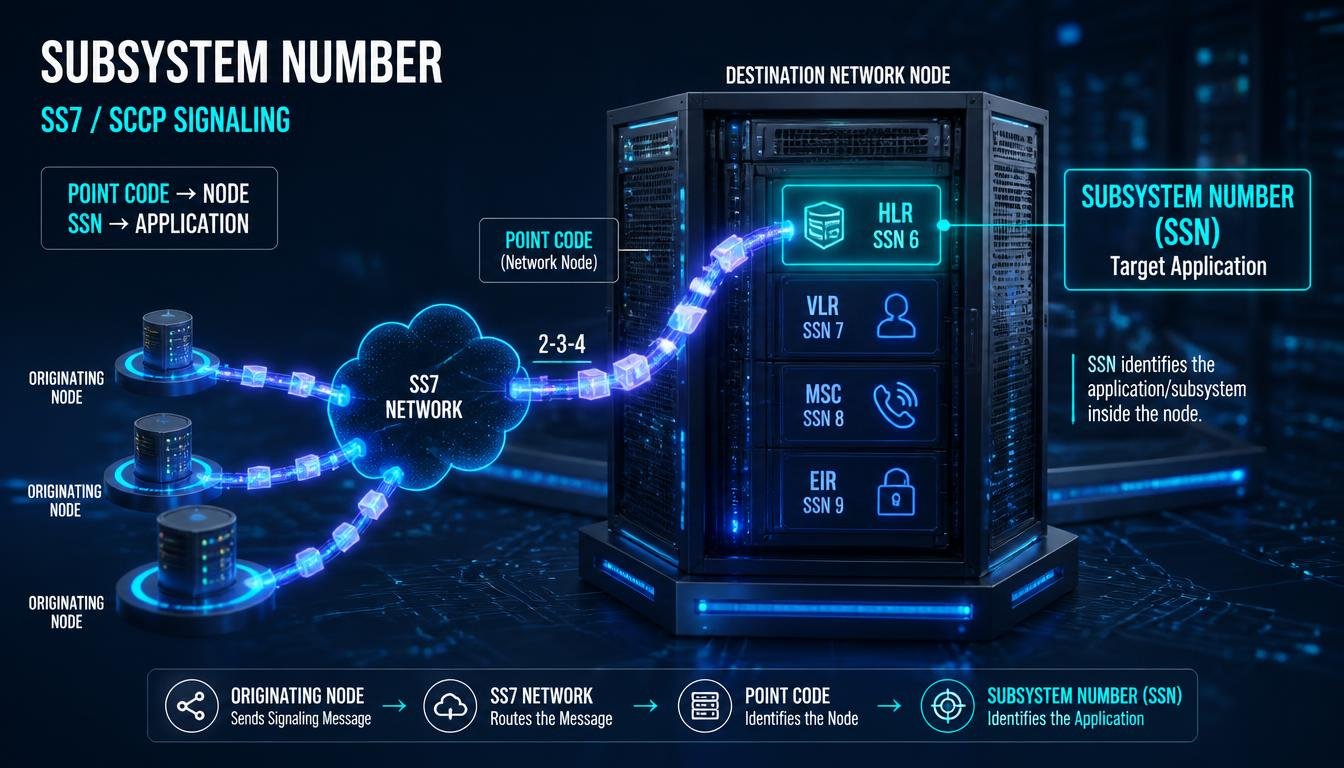
A subsystem number (SSN) is a numeric identifier used in signaling networks to identify a particular application or subsystem within a network node. The term is most closely associated with Signaling System No. 7 (SS7) and the Signalling Connection Control Part (SCCP), where it helps direct signaling messages to the correct application.
Understanding a subsystem number becomes much easier when you separate the identity of the network node from the identity of the application running inside it. A point code identifies the signaling node, while the SSN identifies the relevant subsystem within that node. Together, these addressing elements help a signaling network deliver traffic to the intended destination instead of treating an entire node as a single undifferentiated endpoint.
This distinction is especially important in telecommunications environments involving mobile networks, SS7 signaling, SCCP, MAP, TCAP, and SIGTRAN. Common subsystem numbers are associated with functions such as the Home Location Register (HLR), Visitor Location Register (VLR), Mobile Switching Center (MSC), and Equipment Identity Register (EIR).
What Is a Subsystem Number?
A subsystem number is an identifier for an application or subsystem within a signaling node. In an SS7 environment, SCCP can use this number as part of its addressing information to determine which application should receive a signaling message.
A useful way to understand it is to imagine a large office building. The building represents the network node, while individual office numbers represent applications inside that building. The building address gets traffic to the right location, and the office number gets the message to the appropriate department. In a similar way, the point code identifies the signaling point and the subsystem number identifies the application within that point.
This approach is useful because a single signaling node can support several different applications. Without a way to distinguish those applications, routing would become considerably more complicated. SSN addressing gives SCCP a mechanism for identifying the intended subsystem and supporting communication between signaling applications.
What Does SSN Stand For?
SSN stands for Subsystem Number.
In telecommunications documentation, the abbreviation can appear in discussions about SS7, SCCP, SIGTRAN, MAP, TCAP, routing, and signaling applications. It should not automatically be confused with other meanings of the abbreviation “SSN,” which can refer to completely different concepts in other industries.
In an SS7 context, the subsystem number is specifically associated with the identification and routing of applications that use SCCP signaling. The exact number assigned to an application depends on the applicable standard, network environment, and sometimes the operator’s numbering arrangements.
How Does a Subsystem Number Work?
The basic idea is straightforward: a signaling message needs to reach a particular application, not merely a physical or logical network node.
An SS7 address can contain information such as a signaling point code, subsystem number, and global title information, depending on the addressing and routing method being used. SCCP provides addressing capabilities beyond the basic routing provided by lower SS7 layers. In some situations, a global title can be translated into the information required to reach the final destination.
For example, imagine that a signaling message eventually needs to reach an HLR application. The destination node can be identified by its point code, while the HLR application can be identified by the corresponding subsystem number. The combination allows the network to distinguish the intended application from other applications hosted on the same signaling point.
Point Code vs. Subsystem Number
These two identifiers are related, but they serve different purposes.
| Identifier | What it identifies | Typical role |
|---|---|---|
| Point Code | Signaling node | Identifies the network entity |
| Subsystem Number | Application or subsystem | Identifies the application inside that node |
| Global Title | Address used for translation/routing | Can be translated into a destination address |
| SS7 Address | Combination of addressing information | Helps determine where signaling should go |
The easiest way to remember the difference is: the point code gets you to the node; the subsystem number helps get you to the application.
Common Subsystem Number Values
Several SSNs have standardized associations, particularly in GSM and UMTS environments. Common examples include HLR, VLR, MSC, and EIR applications.
| Subsystem Number | Common Association |
| 1 | SCCP management |
| 3 | ISDN User Part |
| 4 | OMAP |
| 5 | MAP |
| 6 | HLR |
| 7 | VLR |
| 8 | MSC |
| 9 | EIR |
| 10 | Authentication Center |
| 11 | ISDN Supplementary Services |
| 14 | TC Test Responder |
The exact interpretation of a number should always be checked against the relevant standard and network configuration. Some ranges are reserved for international use, while other values are available for national or network-specific applications.
Subsystem Number 6: HLR
One of the best-known examples is SSN 6, which is associated with the Home Location Register in GSM/UMTS signaling environments.
The HLR stores important subscriber-related information and participates in signaling procedures used by mobile networks. When signaling traffic needs to reach the HLR application, the subsystem number helps identify that application at the destination signaling point.
This is why SSN 6 often appears in SS7 and MAP-related configurations and traces. It is not simply an arbitrary number; its association with HLR comes from standardized subsystem-number assignments used in relevant telecommunications environments.
Subsystem Number 7: VLR
SSN 7 is commonly associated with the Visitor Location Register (VLR).
The VLR is involved in managing information associated with subscribers currently being served by a mobile switching area. In signaling configurations, identifying the VLR subsystem separately from the underlying signaling node allows messages to reach the appropriate application.
The same general principle applies: the point code identifies the signaling point, while the SSN identifies the particular subsystem that should process the signaling message.
Subsystem Number 8: MSC
SSN 8 is commonly associated with the Mobile Switching Center (MSC) in GSM/UMTS subsystem-number assignments.
The MSC performs important switching and mobility-related functions within traditional mobile networks. Because a signaling environment may contain many different applications and network elements, explicit subsystem identification helps distinguish MSC-related signaling from other applications operating within the signaling architecture.
Subsystem Number 9: EIR
SSN 9 is commonly associated with the Equipment Identity Register (EIR).
The EIR is related to equipment identity information in traditional mobile network architectures. When signaling needs to reach the EIR application, the corresponding subsystem number provides the application-level destination information used by SCCP-based signaling.
Again, the number itself only has meaning within the relevant signaling and numbering context. It should not be interpreted as a universal identifier across every telecommunications system.
Why Is a Subsystem Number Important?
A subsystem number provides a practical way to distinguish applications within a signaling environment.
Imagine a signaling node hosting several applications. If routing only identified the node, the network would still need another mechanism to determine which application should process a particular message. SSN provides that additional level of addressing.
This becomes especially valuable in large telecommunications networks where multiple services and applications coexist. Clear subsystem identification makes routing, configuration, monitoring, and troubleshooting easier because engineers can identify not only the destination node but also the intended application.
How SSN Works With SCCP
The Signalling Connection Control Part (SCCP) is the SS7 component most directly associated with subsystem numbers.
SCCP provides addressing and routing capabilities that complement the basic signaling functions of lower SS7 layers. An SCCP destination can contain a point code and subsystem number, while global title routing can provide another mechanism for determining the eventual destination.
A simplified routing flow looks like this:
Originating application → SS7 signaling network → SCCP routing → Destination point code → Destination SSN → Target application
The actual signaling process can be considerably more sophisticated, particularly when global title translation, signaling transfer points, and multiple network domains are involved.
Subsystem Number and Global Title Translation
Global Title Translation (GTT) is commonly used in SS7 networks to translate global titles into routing information.
Instead of requiring every signaling application to know the exact point code and subsystem number for every possible destination, a network can use global title information and translation rules to determine where the message should ultimately be delivered.
The result can be a destination consisting of information such as a point code and subsystem number. This makes large signaling networks easier to manage because routing decisions can be centralized or distributed through configured translation rules.
Subsystem Numbers in SIGTRAN
The move from traditional SS7 transport toward IP-based signaling does not eliminate the concept of the subsystem number.
SIGTRAN technologies can transport SS7 signaling over IP networks, while protocols such as M3UA support the transport of signaling information between signaling components. The underlying SS7 addressing concepts, including SCCP subsystem numbers, can therefore remain relevant even when the physical transport environment has changed.
For example, M3UA configurations can include subsystem-number routing toward Application Servers. Commercial signaling platforms document SSN-based routing configurations for this purpose.
Subsystem Number vs. Application Server
A subsystem number and an Application Server are not the same thing.
The SSN identifies a subsystem or application within the SS7/SCCP addressing model. An Application Server, particularly in a SIGTRAN/M3UA environment, represents a logical application or signaling destination that can participate in IP-based signaling architecture.
They can work together in routing configurations, but they describe different layers or concepts within the signaling environment. Confusing the two can make troubleshooting and configuration considerably harder.
Are Subsystem Numbers Globally Unique?
No, a subsystem number should not automatically be treated as globally unique.
In many cases, the meaningful identity is the combination of the destination point code and subsystem number. The same subsystem number can therefore exist at multiple signaling nodes while referring to an application at each respective node.
For example, SSN 6 may identify an HLR at one signaling point and another HLR at a different signaling point. The point code distinguishes the nodes, while the SSN identifies the application within each node.
This is one reason it is important to examine the complete signaling address rather than looking at an SSN value in isolation.
How Subsystem Numbers Help With Troubleshooting
When signaling traffic fails to reach an intended application, engineers can examine the destination addressing information to determine whether the problem is related to the node, subsystem, translation, or routing configuration.
A useful troubleshooting approach is to verify the destination point code, confirm the expected subsystem number, examine global title translation where applicable, and then check whether the destination subsystem is available.
Signaling platforms can also expose subsystem states such as allowed or prohibited. For example, SS7 configuration systems may use subsystem management messages to communicate whether a subsystem is available to the network.
Example Troubleshooting Scenario
Suppose an SS7 message is correctly reaching the expected signaling point but the target application is not processing it.
The point code may therefore be correct while the SSN is incorrect, unavailable, or incorrectly configured. An engineer could compare the destination address against the expected application, inspect SCCP routing information, review global title translation rules, and check the operational state of the subsystem.
This illustrates why looking only at the point code is not always enough. The destination application must also be identified correctly.
Common Mistakes When Working With SSNs
One common mistake is assuming that every SSN has the same meaning in every network. Standardized values exist, but numbering can also depend on the signaling environment, geographic or national arrangements, and operator configuration. Relevant standards should therefore be consulted before changing a production configuration.
Another mistake is treating the subsystem number as a complete destination address. An SSN normally needs to be considered alongside other signaling information, especially the destination point code and, where applicable, global title translation.
A third mistake is confusing SSN with similarly named abbreviations. In telecommunications documentation, context matters. Always confirm that “SSN” refers to Subsystem Number before interpreting the value.
Subsystem Number in Modern Networks
The importance of SSN depends heavily on the network generation and architecture being discussed.
Traditional 2G and 3G mobile networks make extensive use of SS7-based signaling concepts. Later architectures increasingly use IP-based signaling and different service frameworks. Modern 5G core networks, for example, primarily use service-based interfaces rather than relying on the traditional SS7/SCCP model for core service communication.
Nevertheless, legacy networks, interworking systems, signaling gateways, roaming environments, and migration architectures can continue to make SS7 and subsystem-number knowledge relevant. Understanding SSN is therefore still useful for engineers working with telecommunications infrastructure and legacy-to-modern network integration.
Frequently Asked Questions About Subsystem Number
What is a subsystem number?
A subsystem number is a numeric identifier used to identify an application or subsystem within a signaling node, particularly in SS7 networks using SCCP.
What does SSN mean in telecommunications?
In an SS7 telecommunications context, SSN means Subsystem Number. It identifies the relevant subsystem or application that should receive signaling traffic.
What is SSN 6?
SSN 6 is commonly associated with the Home Location Register (HLR) in GSM/UMTS signaling environments.
What is SSN 7?
SSN 7 is commonly associated with the Visitor Location Register (VLR) in GSM/UMTS environments.
What is SSN 8?
SSN 8 is commonly associated with the Mobile Switching Center (MSC) in standardized GSM/UMTS subsystem-number assignments.
What is SSN 9?
SSN 9 is commonly associated with the Equipment Identity Register (EIR) in GSM/UMTS signaling.
Is a subsystem number the same as a point code?
No. A point code identifies a signaling node, while a subsystem number identifies an application or subsystem within that node. They can work together as part of an SS7/SCCP destination address.
Are subsystem numbers unique?
Not necessarily. An SSN can be reused at different signaling nodes. The combination of the point code and SSN provides a more specific destination identity.
Are subsystem numbers still relevant?
Yes, particularly in SS7-based networks, legacy mobile infrastructure, roaming environments, signaling gateways, and systems that interwork between older and newer telecommunications architectures.
Conclusion
A subsystem number is a small but important part of SS7 signaling architecture. Its primary purpose is to identify the application or subsystem that should receive signaling traffic within a particular network node. When combined with a point code, it provides a much more precise destination than a node identifier alone.
The most familiar examples include SSN 6 for HLR, SSN 7 for VLR, SSN 8 for MSC, and SSN 9 for EIR in GSM/UMTS environments. However, the meaning of a specific value should always be checked against the relevant standards and network configuration rather than assumed universally.
If you’re working with SS7, SCCP, MAP, TCAP, SIGTRAN, or signaling traces, understanding the relationship between point codes, subsystem numbers, global titles, and routing can make configuration and troubleshooting much easier. Start by identifying the destination node, then determine which subsystem should handle the message—that simple distinction is the foundation for understanding SSN-based signaling.




Leave a Reply