
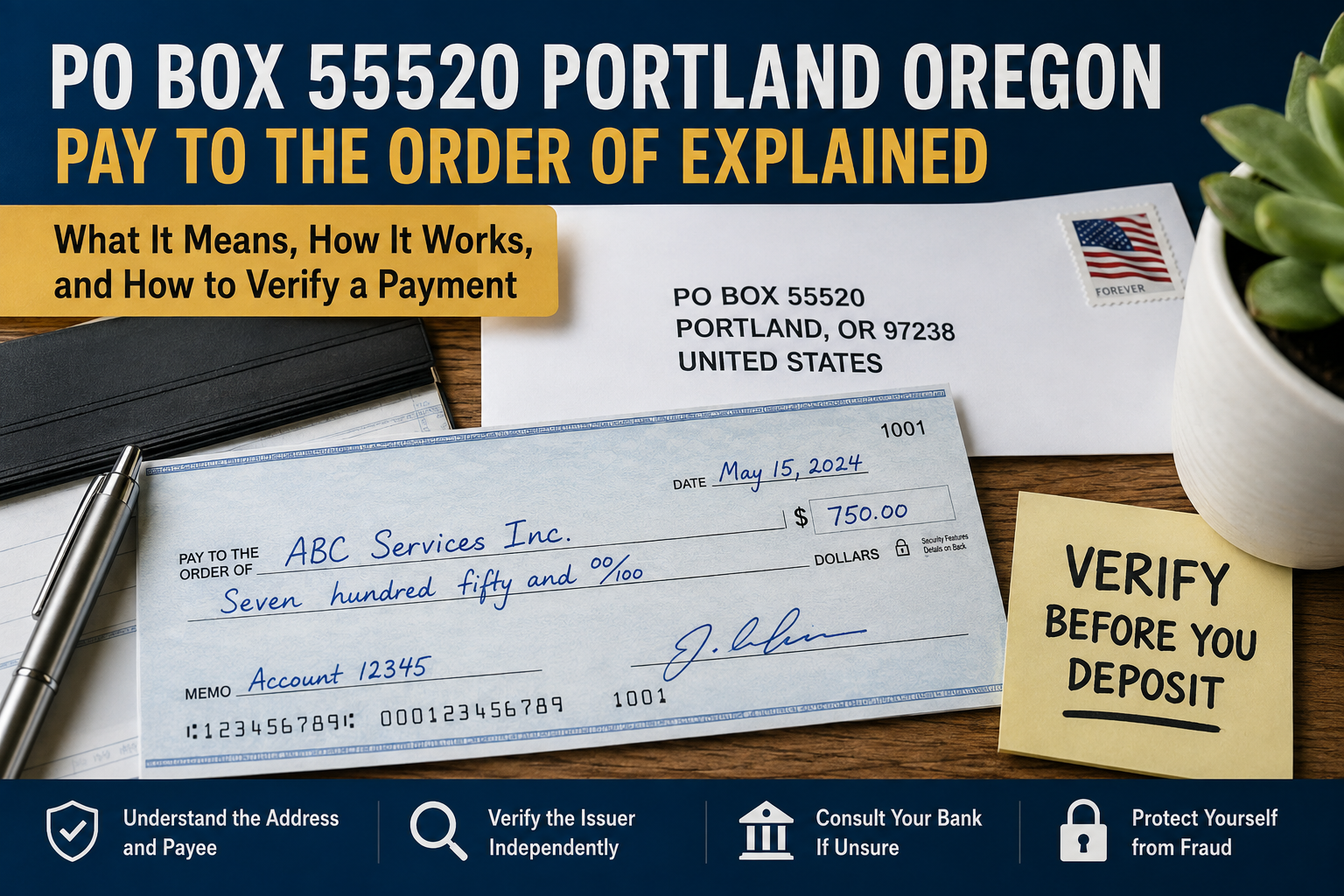
If you have come across the phrase “PO Box 55520 Portland Oregon Pay to the Order Of” on a check, payment instruction, letter, or financial document, it is understandable to have questions. The wording combines a mailing address with standard check terminology, but the address alone does not tell you who issued the payment or whether a particular transaction is legitimate.
There is also an important distinction to keep in mind: a PO Box can identify where mail is directed, while “Pay to the Order Of” identifies the person or organization intended to receive money. Those are two different pieces of information, and confusing them can lead to payment errors.
Public search results currently provide inconsistent information about PO Box 55520 in Portland, so it would be unsafe to claim that the address definitively belongs to a particular company or payment program without documentation from the actual sender. The safest approach is to understand what the wording means, examine the document you received, and independently verify the payment before sending money or depositing an unexpected check.
What Does “PO Box 55520 Portland Oregon Pay to the Order Of” Mean?
The phrase can be understood by separating it into two parts. PO Box 55520, Portland, Oregon is a mailing address, while “Pay to the Order Of” is language commonly printed on checks to identify the intended payee. A mailing address tells you where correspondence or a payment may be sent; it does not, by itself, establish who is entitled to receive the money.
For example, a payment instruction could tell you to make a check payable to a particular organization and mail that check to a PO Box. In that situation, the organization’s name belongs on the payee line, while the PO Box belongs in the mailing-address section. Treating the PO Box number as the name of the payee would be a mistake.
What “Pay to the Order Of” Means
On a standard check, the “Pay to the Order Of” line identifies the person, business, or other payee to whom the payment is made. If the check is payable to “ABC Company,” the company is the named payee; the address printed elsewhere on the document is separate information.
This distinction matters when you’re trying to understand a payment. The address can help you investigate the source, but the payee name, check issuer, amount, date, reference number, and accompanying explanation provide much more useful evidence about what the payment actually represents.
What Is a PO Box?
A PO Box, or Post Office Box, is a designated postal mailing address used to receive mail. Businesses, organizations, government offices, and individuals can use PO Boxes for various reasons, including privacy, centralized mail handling, and maintaining a consistent mailing address.
A PO Box does not necessarily reveal the physical location where an organization operates. It also does not automatically indicate that a payment request is legitimate or fraudulent. The surrounding documentation is what matters.
Why Are PO Boxes Used for Payments?
Organizations that receive substantial volumes of checks or correspondence may use dedicated mailing addresses to organize incoming documents. A payment-processing address can make it easier to separate financial mail from ordinary correspondence and route it to the appropriate department.
However, simply seeing a PO Box on a payment document should not be treated as proof of authenticity. A legitimate organization can use a PO Box, but a scammer can also put a PO Box on fraudulent correspondence. Verification still matters.
Is PO Box 55520 Portland Oregon a Payment Address?
It may be presented as a payment or correspondence address, but available public search results do not provide enough reliable evidence to identify one specific organization as the definitive owner or operator of this particular Portland PO Box.
Some websites describe the address as being associated with payments, refunds, settlements, or other financial correspondence, but these pages do not establish an authoritative connection to a specific organization. Other search results contain unrelated or potentially inaccurate information, which is another reason not to rely on random address directories when verifying a financial transaction.
In practical terms, if this address appears on something you received, the document itself should be your starting point. Look for the issuer’s legal or business name, customer-service information, account or claim number, payment explanation, and other identifying details.
How the Address and Payee Work Together
Imagine you receive payment instructions that contain information similar to this:
| Payment Detail | Example | Purpose |
|---|---|---|
| Pay to the Order Of | ABC Services Inc. | Identifies the payee |
| Amount | $750.00 | Identifies the payment value |
| Memo | Account 12345 | Helps identify the transaction |
| Mailing Address | PO Box 55520, Portland, OR | Indicates where the payment should be mailed |
In this example, ABC Services Inc. is the payee. The PO Box is simply the destination for the mailed payment.
That distinction becomes particularly important if you’re preparing a check. You should generally follow the exact payment instructions supplied by the organization rather than guessing the payee from an address alone.
What Should You Do If You Received a Check From This Address?
An unexpected check deserves verification before you assume it is genuine. A check can look professional and still be associated with a fraudulent payment scheme, so appearance alone is not enough.
Start by identifying who supposedly issued the check. Look at the check, letter, envelope, payment explanation, and any reference number. If the document says the payment relates to a settlement, refund, insurance claim, rebate, account adjustment, or another transaction, determine whether you actually have a relationship with that organization or program.
Check the Payee Name
The first thing to examine is the name printed after “Pay to the Order Of.” If the check is payable to you, confirm that your name is spelled correctly. If it is payable to a business, verify that the business name is accurate.
Do not assume that the Portland PO Box is the payee. The address and payee are separate elements of a financial document.
Examine the Issuer
Look for the name of the organization or financial institution that supposedly issued the check. Compare that information with documentation you already trust, such as an account statement or correspondence you obtained independently.
If the letter provides a phone number, don’t automatically assume that number is trustworthy. For important financial matters, locate the organization’s contact information through an independently verified source and ask whether the payment was actually issued.
Look for a Reference Number
Legitimate payments often have some way to identify the underlying transaction. Depending on the situation, this could be an account number, claim number, invoice number, settlement reference, or other identifier.
A reference number does not prove that a payment is genuine, but it can make independent verification much easier.
How to Verify an Unexpected Payment
The safest approach is to verify the payment through information that does not depend solely on the suspicious document.
| Verification Step | What to Check |
| Identify the issuer | Who supposedly sent the payment? |
| Check the payee | Who is named after “Pay to the Order Of”? |
| Review the explanation | Why was the payment issued? |
| Verify independently | Contact the organization through trusted contact information |
| Ask your bank | Request guidance if the check appears suspicious |
| Keep documentation | Save the letter, check, envelope, and related records |
This process is especially important when the payment is unexpected or unusually large. Taking a few extra minutes to verify the transaction can prevent much bigger problems later.
Can a PO Box Be Used for Legitimate Checks?
Yes. There is nothing inherently suspicious about a PO Box being used for financial correspondence or check payments. Businesses and organizations can use mailing addresses for payment processing, billing correspondence, and other administrative purposes.
The key point is that the existence of a PO Box does not establish legitimacy. You should judge the transaction based on the complete set of information surrounding it.
For example, an expected refund from a company you already deal with is very different from an unsolicited check that promises a large amount of money and asks you to send part of it somewhere else.
Warning Signs of a Suspicious Check
Be especially cautious if the letter or payment comes with unusual instructions. Requests to send money back, purchase gift cards, transfer cryptocurrency, pay an upfront “processing fee,” or provide sensitive banking credentials are significant warning signs.
Another concern is pressure. If the sender says you must deposit the check immediately, keep the payment secret, or transfer money before a deadline, slow down and independently verify the transaction.
Never Assume a Deposited Check Has Fully Cleared
One of the most important points about check fraud is that money appearing in your account does not necessarily mean the check is genuine or permanently settled. Banks may make funds available before a fraudulent check is ultimately identified.
If someone sends you a check and then asks you to send part of the money elsewhere, do not assume that the transaction is safe simply because your account balance increased.
What If the Check Is Related to a Settlement?
Settlement payments can sometimes arrive through third-party administrators or centralized mailing operations. If you believe a check is connected to a legal settlement, look for the settlement name, claim reference, administrator information, and official documentation.
Do not rely solely on the phrase PO Box 55520 Portland Oregon to determine which settlement issued the check. Search for the settlement using information printed on the official notice or contact the relevant organization through independently verified information.
What If the Payment Is a Refund?
Refunds can also arrive by mail. A company may issue a refund because of an account adjustment, returned payment, cancelled service, overpayment, or another legitimate reason.
If you don’t remember requesting or expecting a refund, investigate it before depositing the check. Check your previous statements and account history, then contact the company using a trusted customer-service channel.
What If Someone Asks You to Send Money Back?
This is where extra caution is necessary. A common fraudulent pattern involves receiving a check, being told that it represents an overpayment, and then being asked to return part of the money through a different payment method.
Do not send money simply because the check appears to have been accepted by your bank. Instead, explain the situation to your bank and independently contact the alleged issuer. The safest decision may be to wait until the payment’s authenticity has been properly established.
Common Mistakes to Avoid
Mistake 1: Treating the PO Box as the Payee
The PO Box is an address. The “Pay to the Order Of” line identifies the payee. Don’t substitute one for the other when completing a payment.
Mistake 2: Trusting the Address Alone
A familiar-looking city, state, or PO Box does not prove who sent the document. Verify the issuer and the reason for payment independently.
Mistake 3: Acting Under Pressure
Legitimate financial transactions generally don’t require you to panic. If someone is pressuring you to deposit, transfer, or return funds immediately, pause and investigate.
Mistake 4: Sharing Sensitive Information
Don’t provide passwords, online banking credentials, security codes, or unnecessary personal information to someone merely because they claim to be associated with a payment.
Mistake 5: Assuming Search Results Prove Ownership
Internet search results can contain outdated, scraped, duplicated, or incorrect information. Current results for this particular PO Box include conflicting claims, so online directories should not be treated as definitive proof of ownership.
A Simple Example
Suppose you receive a letter containing a check for $1,200. The document references a company you’ve used before and provides a payment explanation. The check is payable to your name, while the accompanying instructions mention PO Box 55520, Portland, Oregon.
Instead of assuming the address proves the check is legitimate, compare the payment with your account history. Then contact the company through a trusted channel and ask whether the check number, amount, and reference number match its records.
If the company confirms the payment independently, you have substantially stronger evidence than you would have from the mailing address alone.
What Information Should You Keep?
If you’re investigating an unexpected payment, retain the original letter, check, envelope, reference numbers, and any related account statements. These details can help your bank or the issuing organization investigate the transaction.
Avoid throwing away the documentation until you’ve established what the payment represents. If you communicate with the supposed issuer, keep notes about when you contacted them and what information they provided.
Frequently Asked Questions
What does “Pay to the Order Of” mean?
“Pay to the Order Of” identifies the person or organization designated to receive a check. It is different from the mailing address printed elsewhere on the document.
Does PO Box 55520 Portland Oregon prove who sent my payment?
No. A mailing address alone does not establish the identity of the payment issuer. Public information available online is inconsistent, so the sender’s name, documentation, reference number, and independent confirmation are more reliable indicators.
Is a check mailed from a PO Box automatically suspicious?
No. Legitimate organizations can use PO Boxes for correspondence and payment processing. What matters is whether the payment can be independently verified and whether the surrounding instructions make sense.
Should I deposit an unexpected check?
You should verify the payment first, particularly if you do not recognize the sender or weren’t expecting the money. If anything seems unusual, discuss it with your bank before taking further action.
Why would a company use a PO Box for payments?
A PO Box can provide a centralized destination for incoming mail and financial documents. It can also help organizations separate payment correspondence from other business mail.
What should I write on a check if the instructions mention this PO Box?
Use the exact payee name provided by the organization on the “Pay to the Order Of” line. Use the specified PO Box as the mailing destination. Do not guess the payee based solely on the address.
Can a legitimate settlement use a PO Box?
Yes. Some organizations and payment administrators use centralized mailing addresses. But the PO Box itself does not prove that a particular settlement issued the payment.
What should I do if someone asks me to return part of a check?
Stop and verify the situation before sending any money. Contact your bank and independently contact the organization that supposedly issued the payment. Be particularly cautious if you’re asked to use gift cards, cryptocurrency, wire transfers, or another irreversible payment method.
Can I identify the owner of PO Box 55520 from online search results?
You should not rely on public people-search or scraped directory pages to establish ownership. Current search results contain conflicting information, and some pages associate the address with unrelated individuals or claims.
What is the safest way to verify a payment?
Start with the original document, identify the issuer and payee, then contact the alleged organization through independently verified contact information. If you’re still uncertain, ask your bank for guidance before depositing or transferring funds.
The Bottom Line
The phrase “PO Box 55520 Portland Oregon Pay to the Order Of” combines two different pieces of financial information: a mailing address and a designation of the intended payee. Understanding that distinction makes it easier to interpret checks, payment instructions, refunds, and other financial correspondence.
At the same time, the specific PO Box should not be treated as proof that a payment is legitimate or that it belongs to a particular organization. Public information currently available about this address is inconsistent, so a responsible verification process should focus on the actual issuer, payee, payment explanation, reference information, and independent confirmation.
If you’ve received a payment connected with this address, don’t rush. Review the document carefully, verify the issuer through trusted channels, and speak with your bank if anything doesn’t add up. A few minutes of verification can be far more valuable than acting on an assumption.




Leave a Reply